
[ad_1]
More than half of NSW strata buildings have serious defects. Buy into the wrong complex, and one document could quietly lock you into years of extra costs you can’t easily escape.
Buying a strata property can be a minefield, but the biggest risks are often hidden until it’s too late.
In NSW, with one-third of all strata developments in Australia, 53% of strata buildings have reported serious defects in common property, according to a 2023 survey by the Office of the Building Commissioner and Strata Community Association of NSW (SCA).
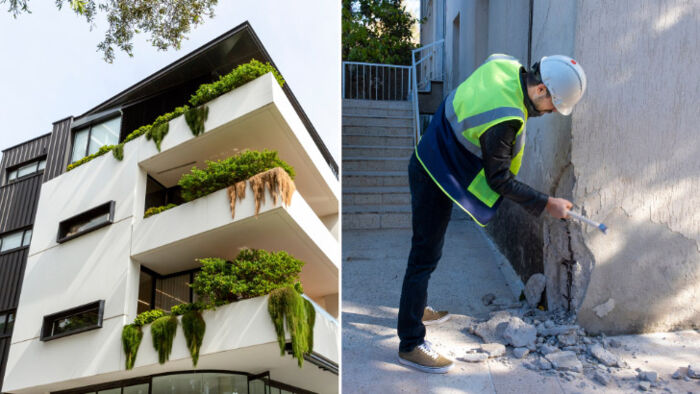
The most prevalent defects are related to waterproofing, fire safety systems, structural issues, building enclosures and, increasingly, building services such as lifts and plumbing.
Mixed-use can quietly drive up your costs
Problems with strata living or investing can be compounded if the strata you buy into is also part of a mixed-use development, for example shops below and apartments above, and is governed by a building management statement (BMS) or a strata management statement (SMS).
These documents regulate shared areas between different entities, setting out how they will be managed and funded.
A building management committee (BMC) is the body responsible for carrying out the rules set out in the SMS or BMS and is made up of representatives from each of the different schemes.
The very nature of a mixed-use complex indicates a plethora of interests, including the residential owners or tenants, the commercial landlords (often the original developers), the commercial tenants, local authorities, customers and visitors, generally, according to legal firm Bannermans, which specialises in construction, strata and property development law.
“The potential for conflicts between these often-competing needs and interests is very real.”
Mixed-use developments are becoming more common, says David Glover, managing director of the owners corporation network (OCN).
And the problem with many BMSs is that they are drafted by the developer and registered before residents move in.
Strata jargon, decoded
BMS (Building Management Statement)
Rules for how shared spaces between residential and commercial areas are managed and paid for
SMS (Strata Management Statement)
Similar to a BMS, used in multi-layered strata developments
BMC (Building Management Committee)
The group that makes decisions about shared areas and costs
SCA (Strata Community Association)
Industry body representing strata managers and stakeholders
Why apartment owners often foot the bill
“Decisions made at development approval stage will directly shape the governance, financial sustainability and liveability outcomes for thousands of current and future residents,” says Glover.
“Poorly structured or inequitable BMSs create persistent governance and financial problems.”
Strata expert Professor Cathy Sherry of Macquarie Law School agrees that mixed-use developments are becoming more prevalent.
In the current, frenzied, simplistic push for high-density development, there has been a marked growth in stratum subdivision, which combines retail, commercial and residential development in large high-rise estates, serviced by complex infrastructure and governed by largely unregulated management statements drafted by developers,” said Sherry in an article in The Sydney Morning Herald in February 2024.
Problems are emerging with BMC structures, says Glover.
These include “inequitable distribution of costs, with residential owners often subsidising commercial infrastructure and locked in cost allocation formulas that are difficult or impractical to amend, even when they become clearly unfair”.
Other problems that can disadvantage residential owners identified by the OCN include diffuse accountability for shared infrastructure, increasing long-term building deterioration and financial risk for residents, and limited transparency and indirect representation of residential owners who cannot participate directly in BMC decision-making.
“I could never see myself buying into a strata development with a BMC,” says Glover.
Watch for these warning signs
- High or rising levies with unclear causes
- Frequent disputes in meeting minutes
- Little mention of defects or repairs
- Complex cost-sharing arrangements
What it is really like to live with a building management committee
I can understand his position from my own experience because I bought into such a development without fully understanding the ramifications.
Mine covers four separate schemes and we all have one vote out of four, yet the residential scheme pays the lion’s share of the considerable levies required to run the BMC.
One big frustration of living in shared property is that everything that needs to be done to keep my home liveable seems to take such a long time.
Decisions about many things, from upgrading landscaping or just undertaking necessary repairs to common property, can drag out because of governance deadlocks and disputes between competing interests, sometimes compounded by a lack of regular BMC meetings.
The owners of the apartments, especially those who call them home, generally want their buildings and facilities to be maintained to a certain standard and not have to wait for months or even years for things to be brought up to scratch.
The commercial owners, whose tenants usually occupy their spaces during business hours, don’t generally have the same priorities.
Why these arrangements rarely change
The bad news is that these arrangements, usually designed by developers to suit their own commercial purpose, can go on forever, says Glover, sometimes 50-100 years.
They can only be changed by the unanimous agreement of all members or by order of the Supreme Court.
“I know of a strata committee that sought legal advice on the prospects of dismantling a BMC arrangement. It cost them $75,000 just to consider whether it was a good idea or not and they were told they had no prospect of success,” says Glover.
He thinks, eventually, that informed consumers may turn away from buildings with BMCs attached, which may spur change.
In the meantime, your best protection, if you are buying into any strata development, is to conduct your own strata search, says Glover. Scrutinise both the minutes of meetings and the notices of meetings for at least three years, he says.
“If something bad is going on, there will be some hints somewhere. If you’re not reading anything about building problems, then the owners committee and strata manager are likely hiding something.”
Get stories like this in our newsletters.
[ad_2]
Source link