
[ad_1]

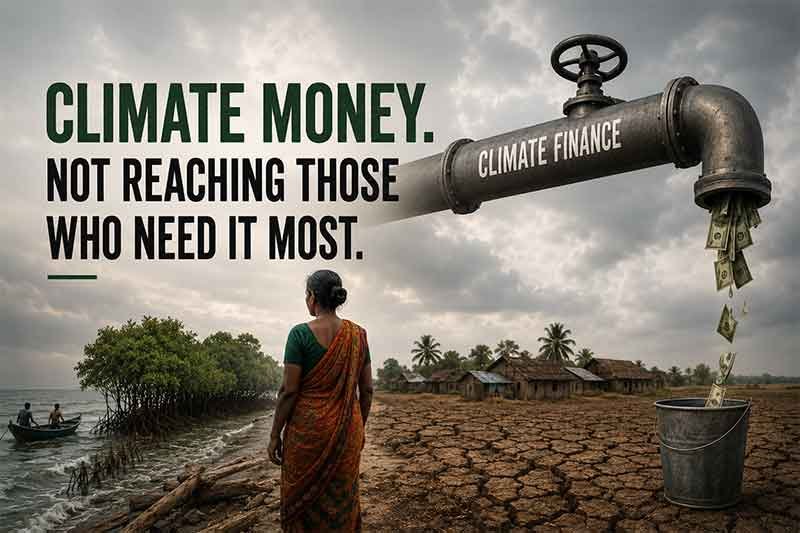
The idea behind climate finance is pretty simple: wealthy nations got rich by burning fossil fuels for a couple of hundred years, while poorer nations are now facing the harsh consequences of that. Because of this historical responsibility, rich countries should provide financial support to poorer countries to help them adapt. It’s not about charity but rather about fairness and accountability.
In theory, we have the structures in place to facilitate this. The Green Climate Fund (GCF), created under the United Nations Framework Convention on Climate Change (UNFCCC) in 2010, was designed to direct funds from developed to developing countries. For instance, India has received commitments totalling $782.4 million from the GCF to support various projects, including those focused on coastal resilience, clean energy, and improving livelihoods. In November 2025, India presented a new climate finance mechanism linked to its first National Adaptation Plan, which is also backed by the GCF. There are many frameworks being established, and plans are getting drafted.
Meanwhile, people in climate-vulnerable zones—coastal Odisha, Vidarbha farmland, Assam slums—remain exposed and unprotected, while help continues to be delayed.
A Growing Financial Divide
To understand how climate finance operates in India, we first need to recognise the global context: there’s just not enough money out there. According to the UN Environment Program’s Adaptation Gap Report for 2025, developing countries face an annual gap in adaptation finance ranging from $187 billion to $359 billion. While international public finance for adaptation reached $28 billion in 2022, it declined to $25.9 billion in 2023. The goal set out in the Glasgow Climate Pact to double adaptation finance to $40 billion by 2025 seems unlikely to be achieved. Even if it were, the UNEP estimates that this would only address about five per cent of the existing adaptation gap.
Adaptation suffers from chronic underinvestment. Essential projects—seawalls, drought-resistant crops, mangrove restoration—go unfunded because private finance refuses to back efforts offering little profit. As a result, progress depends on scarce public money and sluggish multilateral funds. Despite GCF billion-dollar commitments, most communities still wait, trapped by slow bureaucracy.
Where the Money Goes—or Doesn’t
Let’s take a closer look at a specific GCF-funded project aimed at adaptation in India. The $43 million coastal resilience project, run through the United Nations Development Programme (UNDP), focuses on restoring mangroves and creating climate-adaptive livelihoods for vulnerable coastal populations in Odisha and elsewhere. The goals sound great: they include community conservation efforts and restoring coastal ecosystems.
However, the journey the money takes is convoluted. The GCF allocates funds to UNDP, which then coordinates with national government agencies. Those agencies work with state governments, which in turn collaborate with district offices. Finally, the money trickles down to local NGOs or contractors. By the time the funds pass through all these layers, each adding its own costs for administration and oversight, what actually reaches the community in coastal Odisha is significantly less than what originated in Geneva.
This problem is not unique to India or simply a matter of corruption; it reflects a broader structural issue in how multilateral climate finance operates. Complex funding and reporting requirements often favour large international NGOs and consulting firms that have the resources to navigate bureaucratic systems, while local community organisations are pushed aside despite having the deepest understanding of local climate vulnerabilities. As a result, climate projects are frequently designed and managed externally, with funds flowing toward consultants, contractors, and administrative structures rather than directly supporting community-led adaptation work.
Insights from India’s Own Framework
India’s National Adaptation Fund for Climate Change functions on a domestic level, operating through state governments and agencies like NABARD. Project documents from this fund reflect similar structural patterns: a large portion of the budget goes toward feasibility studies, technical assistance, and project management, while direct financial support for local communities tends to be limited.
India’s first National Adaptation Plan, which received GCF support and was approved in September 2024, is an important step forward. However, there’s a concern that if this planning process mirrors the same institutional frameworks as prior adaptation efforts, it may result in yet another layer of detailed plans and additional agencies overseeing implementation, without fundamentally changing who has control over vital resources or whose needs are prioritised.
What Truly Matters and Who Gets to Decide
The communities in India that face the brunt of climate risks are not just waiting around for solutions handed down to them. Take, for example, the Adivasi communities in Odisha’s Niyamgiri Hills, who have sustainably managed their forests for generations, utilising local knowledge. Fishing communities in the Sundarbans have crafted their own responses to changing cyclone patterns. Women farmers in regions across central India have preserved diverse seed varieties that provide the crop resilience that expensive external interventions aim to achieve.
The problem is not that frontline communities lack knowledge or capacity, but that climate finance systems are designed in ways that exclude them. Complex grant requirements, detailed reporting structures, and long-term planning frameworks make it difficult for grassroots organisations to directly access funding, despite their deep understanding of local climate realities. The UNEP Adaptation Gap Report 2025 argues that adaptation finance must move toward more community-led and anticipatory approaches by reducing administrative barriers, ensuring more funds reach local groups directly, and strengthening the ability of communities to manage resources themselves rather than relying on intermediaries.
For journalists and activists: file RTIs for project budget breakdowns under India’s GCF-backed programmes. Ask specifically what percentage went to consultancies, PMUs, and technical assistance versus direct community grants and local labour. The numbers, when they become visible, are where the accountability starts.
The idea behind climate finance is that those countries and communities least responsible for climate change shouldn’t have to navigate a lot of red tape to get the support they need. Unfortunately, while this principle is often mentioned, it doesn’t hold up when money is actually distributed, creating real climate injustice.
Subscribe to Our Newsletter
Get the latest CounterCurrents updates delivered straight to your inbox.
Utkarsh Mishra is a journalist based in Ranchi writing on law, labour rights, and the environment. His work has appeared in Feminism in India, The India Forum, Down to Earth, The Policy Circle, Verdicto News and Zee News.
[ad_2]
Source link