

Despite surging inflation and an ongoing war in the Middle East, the S&P 500 (^GSPC 0.16%) has remained resilient. The index has soared by nearly 17% since late March alone, as of this writing, and it’s up by around 31% over the last 12 months.
This bull run has bolstered many investors’ confidence, with around 67% feeling either optimistic or neutral about the next six months, according to the most recent weekly survey from the American Association of Individual Investors. That’s up from around 57% a month ago.
That said, several stock market metrics suggest the S&P 500 could be due for a pullback. While this doesn’t necessarily mean we’re on track for a major recession or bear market, it’s a good opportunity for investors to consider adjusting their strategy.

Image source: Getty Images.
Data suggests the S&P 500 might be overvalued
Company valuations have skyrocketed in recent years, driven in large part by tech companies and advances in artificial intelligence (AI). While it’s normal, to a degree, for companies to trade at higher valuations, many are overvalued in this incredibly pricey market.
The S&P 500 Shiller CAPE ratio, or the cyclically adjusted price-to-earnings ratio, measures the current price of the S&P 500 against the 10-year moving average of its inflation-adjusted earnings. It’s used to predict future returns, and historically, a higher ratio has often led to a market decline.
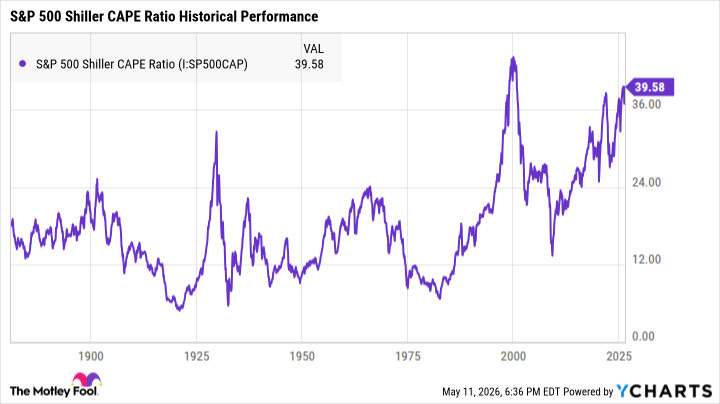
S&P 500 Shiller CAPE Ratio data by YCharts
There are only two points in history when the Shiller CAPE ratio saw a sudden spike. The first was leading up to the Great Depression in the 1920s, and the second was just before the dot-com bubble burst in the early 2000s. The metric is now close to 40, as of this writing, which is its second-highest point in history.
The S&P 500 Shiller CAPE Ratio isn’t the only metric sounding the alarm over market valuations. The Buffett indicator — named after Warren Buffett when he used it to correctly predict the onset of the dot-com bubble — is also raising red flags.
While the Buffett indicator also measures whether the market is over- or undervalued, it does so by comparing the total market value of U.S. stocks to U.S. GDP. The higher the ratio, the stronger the chances that the market is overvalued. In Buffett’s own words, once the indicator nears 200%, investors are “playing with fire.” As of this writing, the Buffett indicator sits at around 228%.
Is a stock market crash coming in 2026?
Nobody knows what the market will do in the near term, but a downturn is almost certain to happen at some point. Stock prices can’t continue climbing forever, so eventually, there will need to be a pullback.
Perhaps the best thing investors can do to prepare is to exercise caution in choosing stocks. To be clear, right now is not a bad time to invest. Both the S&P 500 Shiller CAPE ratio and the Buffett indicator have been elevated for months, yet the S&P 500 has continued to soar. In other words, those who stopped investing at the first sign of trouble would have missed out on lucrative returns.
It’s crucial, though, to ensure you’re doing your research. It’s possible for a stock to thrive despite having shaky fundamentals, especially if its success is fueled mostly by hype. Those stocks may look strong on paper, but they’re more likely to crash hard if the market turns sour.
Companies with robust foundations, however, are more likely to have what it takes to survive a downturn. By loading up on these stocks and holding them for at least a few years, your portfolio has a much better chance of thriving over time — even if we face a recession or bear market.