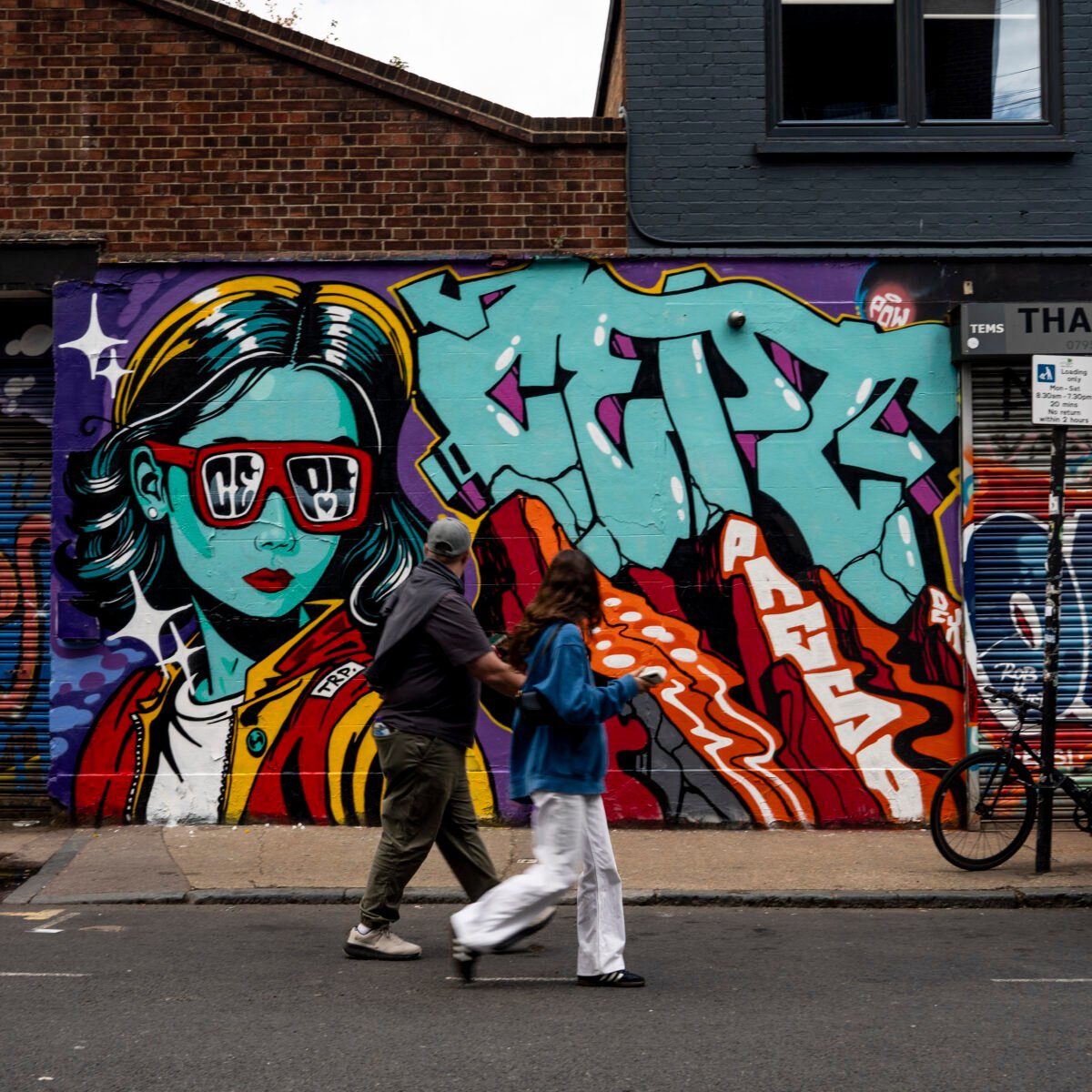
From railway tunnels and East London shop shutters to canvases and collectors, CEPT has spent four decades following the possibilities of paint. In this interview, he reflects on the origins of his name, the alter egos at the heart of graffiti, his relationship with LAX and why commercial success has never changed the work.
Instagram Preview
For CEPT, graffiti began with a love of letters and became a way of life. He started writing in 1986, found his name around 1988 and later made East London’s shutters, bridges and disused spaces his canvas. What began outside the approval of the mainstream now hangs in galleries, but the motivation remains the same.
“CEPT still means freedom and adventure, creativity and evolution to me.
“CEPT got me out of the house when I was 15 and helped me explore life, escape normality, meet so many interesting people and travel doing what I love.
“It still means that to me today.
“Art is my aeroplane.”
Read the full interview to discover how comic books, hip hop, London and four decades of painting shaped CEPT’s visual world.
The Beginning of CEPT
This CEPT graffiti artist interview begins not with the art market, a gallery wall or even a spray can, but with letters. Before graffiti entered his life, the future artist was already absorbed by the dramatic forms of heavy metal logos. Then a single book opened the door to an entirely new visual culture.
“I started writing graffiti in late 1986. I first wrote Kid, Script and Case, and then settled on CEPT in about 1988.
“I was already into drawing before I saw graffiti. I was drawing a lot of heavy metal band logos, Iron Maiden, Sabbath, Saxon, Whitesnake, AC/DC. I loved drawing letters, so seeing Subway Art for the first time blew me away. I became completely obsessed with graffiti from then on.”
There was no obvious path from graffiti to an artistic career. Its position outside accepted culture was part of the reality and the attraction.
“Graffiti was hated by the mainstream for a long time, and I never thought it would be something you could have a career in because it was all illegal back then.
“It never occurred to me that people would even let us paint walls legally, never mind getting paid.”
What pulled him in was immediate: “It was the letter styles and colours that got me, and the different dynamics of the different letter styles. Then there was the adventure of painting at night and breaking the rules.”
From London Streets to the Studio: A CEPT Graffiti Artist Interview
Growing up in a small village, CEPT and a friend were the only writers locally. They painted railways, tunnels and bridges, but recognition took on a different meaning after he returned to London in 1995. There, the work had what he calls “a proper audience”. East London offered room to act, and CEPT made use of it.
“Then I really concentrated on shop shutters, which no one was doing back then. I think that’s when people started really seeing me up. I had some mad spots, with full-on burners right on the street, from Stoke down to Shoreditch. Hackney Road had a lot.
“I also started rolling big pieces on old Texaco petrol stations that were closed down during that time.
“The Wick was a playground for painting. There was no graffiti there then. There were some great parties out there, and I’d go painting on the way home.”
CEPT remembers police routinely stopping to check whether he had permission to paint shutters in daylight. Today, he says, graffiti is so familiar that officers often appear to assume permission has been granted. The streets are more saturated, yet he still values the writers who cover them with throw ups.
That history remains present in the studio, although the rhythm changes. A wall calls for speed, scale and instinct; a canvas allows reconsideration.
“Painting on the street is pure fun and energy. I paint fast and don’t really think too much about what I’m painting because I have the idea in my head. It’s more like an action for me, a bit on autopilot.
“I like painting big. Empty cans, fat caps all the way.
“Studio work is far more considered and patient, and it evolves as the painting goes on. I’m more likely to change bits as I’m working on a canvas, let it rest for a while and work on a few at a time.
“I get really impatient, so I need to step away for a bit.”
The first sight of his work on canvas felt strange: contained and neat after the street. That containment also became part of the appeal. For CEPT, neither location has a greater claim to freedom or authenticity. “I feel free whenever I paint. It’s pure me. I’m making what I want, whether it’s on the street or a canvas. It’s the same authenticity, just a different process.”
Comic Books, Characters and Alter Egos
A central theme of this CEPT graffiti artist interview is continuity. Each new work, he says, carries the memory of everything made before it. “I think every painting I make is stacked on top of all my experiences as a painter. Every piece I’ve made previously is ingrained in any new painting. It’s the spirit and sensibility that remains throughout all my work, and my journey up to the latest painting.”
Comic books, science fiction and sign painting converge within that accumulated visual language. CEPT’s earlier work drew heavily on pop art and comics; the more realistic figures in recent paintings are imagined characters of his own creation: “sci-fi, post-apocalyptic galactic travellers. Marking time.” Romantic imagery traces back to comics of the early 1970s, removed from its original context and paired with song titles or lyrics. The viewer, however, is never handed a complete narrative. “I just provide the entry point. They can make their own story for the characters I paint.”
The superhero remains especially important because, for CEPT, it reflects the psychology of graffiti itself.
“The superhero-type characters are a direct link to graffiti writing.
“We create these alter egos that paint huge pieces and project this image of our chosen names, trying to paint in lots of different places.
“When you see someone who paints big and paints a lot, you imagine this character that’s larger than life, making these images appear everywhere.
“Superheroes are alter egos of ordinary people, Clark Kent, etc. It’s a duality. Everyone who paints has a given name too.”
Music is another foundational influence, though not always a soundtrack to the physical act of painting. CEPT listens while designing and sketching at home, but prefers quiet at a wall or in the studio, where concentration matters. Hip hop has nevertheless remained central to his life. Its methods also offer a way to understand his approach: “The sampling in my work is a visual representation of the music I love, taking different, diverse elements and mixing them into new formats.”
Working With LAX
His relationship with London Art Exchange began through a friend, Alex. What followed was built on conversation, professional trust and a sense that the gallery understood both the work and the history behind it.
“When I first met LAX, they were cool, straightforward, relaxed, honest and very professional, which is refreshing because a lot of galleries aren’t.
“We hung out at the studio and chatted a lot. They understood my work, and it felt right to work with them.”
That understanding matters because CEPT does not separate the paintings from the culture and experience that produced them. He believes it is vital for a gallery to value an artist’s journey and cultural background. For anyone encountering his work through LAX for the first time, his advice is to look backwards as well as at the present: studying the earlier work offers insight into the evolution visible in his paintings now.
Graffiti, Value and Artistic Legacy
CEPT has watched graffiti move from being despised by the media and excluded by the traditional art world to becoming part of mainstream culture and daily coverage. The shift has created opportunities for artists to make a living from their work, but acceptance has brought complications too.
“It’s great to see artists making a living from what they love. The downside is that the real culture gets watered down and misrepresented at times.
“But hey, everything changes and evolves. You’ve got to move forward and evolve as an artist.”
One of his first canvas sales came through Flickr. He met the buyer and was paid in cash, an unfamiliar transaction after making thousands of pieces on the street for free. The experience confirmed that the work was valued and made it possible to produce more. Yet commercial success, he insists, has not altered his decisions: “No. Being commercially valued changes nothing. I make work for me. If others like it, then that’s great.”
For a wider look at the questions surrounding ownership and value, read Investor Fact Check’s guide to art and collectibles valuation.
Nor does he accept the idea of a single gatekeeping art world. “I don’t believe in one ‘Art World’. There are many art worlds that coexist.” What matters is that artists can survive from their work. In CEPT’s case, collecting a painting also means engaging with something larger than the object itself.
“When someone buys one of my pieces, they’re buying into my legacy and my history, not just the singular piece that they can hold.
“They’re buying into the history of the visual landscape of London.”
Freedom, Adventure and Evolution
After nearly four decades, possibility rather than arrival still defines the work. CEPT continues to move across spray paint, oil, acrylic and collage, pursuing evolution in medium as well as subject. Asked what remains to be achieved, his response leaves the future deliberately open: “There’s lots that I still want to achieve and lots of ways I want to better myself as an artist. You’ll have to wait and see.”
The CEPT graffiti artist interview closes where it began: with the name. The adolescent identity has endured because its meaning has endured with it.
“CEPT still means freedom and adventure, creativity and evolution to me.
“CEPT got me out of the house when I was 15 and helped me explore life, escape normality, meet so many interesting people and travel doing what I love.
“It still means that to me today.
“Art is my aeroplane.”