
[ad_1]
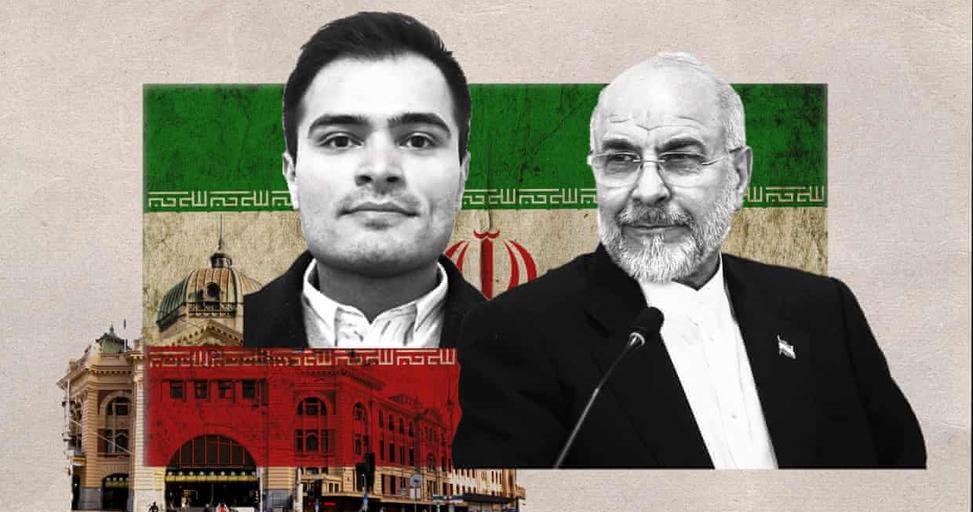
In a report published on Monday, May 11, The Guardian revealed connections between Ishaq Qalibaf, the son of Mohammad Bagher Qalibaf, and a research center at the University of Melbourne, as well as his investments in the Australian real estate market.
According to the report, during his years of residency in Australia, Ishaq Qalibaf generated income through the rental of at least one property in Melbourne and simultaneously succeeded in obtaining long-term Australian residency. This occurred despite his Canadian visa applications having been rejected twice.
The Guardian reported that Ishaq Qalibaf, 38, arrived in Melbourne in 2014, where he initially enrolled in English language and foundation courses. He subsequently studied engineering at the University of Melbourne between 2015 and 2018, residing in the South Yarra neighborhood.
Documents submitted as part of his Canadian permanent residency file indicate that Ishaq Qalibaf served as a research assistant at the University of Melbourne’s Centre for Spatial Data Infrastructures and Land Administration between 2016 and 2018. According to these records, he worked approximately seven hours per week at the center during academic terms.
The Guardian further reported that bank statements belonging to Ishaq Qalibaf show that in 2018, he received two separate monthly payments of AUD 1,353 from a Melbourne real estate firm. The transactions were labeled as “rent received from tenants.” The newspaper noted that it remains unclear how the property was purchased or under what specific ownership structure it was held.
The report raises questions regarding how the son of Mohammad Bagher Qalibaf, the former Commander of the IRGC Air Force and former Chief of the Police Force, was able to obtain temporary residency in Australia and derive income from local real estate.
The Guardian’s report also critiques Australia’s enforcement of sanctions against current and former IRGC officials and their family members. Unlike Canada, the Australian government has not yet imposed any sanctions against Mohammad Bagher Qalibaf.
Kylie Moore-Gilbert, who was imprisoned in Iran for over 800 days, told The Guardian that the presence of the children of high-ranking Islamic Republic officials in Australia highlights the government’s weakness in vetting and restricting the entry of those close to the regime.
[ad_2]
Source link


