
Warren Buffett surprised Berkshire Hathaway (BRK.A 0.56%) (BRK.B 0.56%) shareholders in May when he announced his retirement as CEO, effective at the end of the year. While Greg Abel has long been the presumed successor to Buffett as CEO of the conglomerate, the timing of the transition had been up in the air for years.
Buffett’s comments during the May shareholder meeting and his actions since suggest he’s not going to change anything about how he runs Berkshire up until his retirement. That includes the company’s massive marketable equity portfolio, which is currently valued at over $300 billion. But as he heads into retirement, Buffett is leaving investors with a clear warning about the stock market and exemplifying what investors should consider going into 2026.

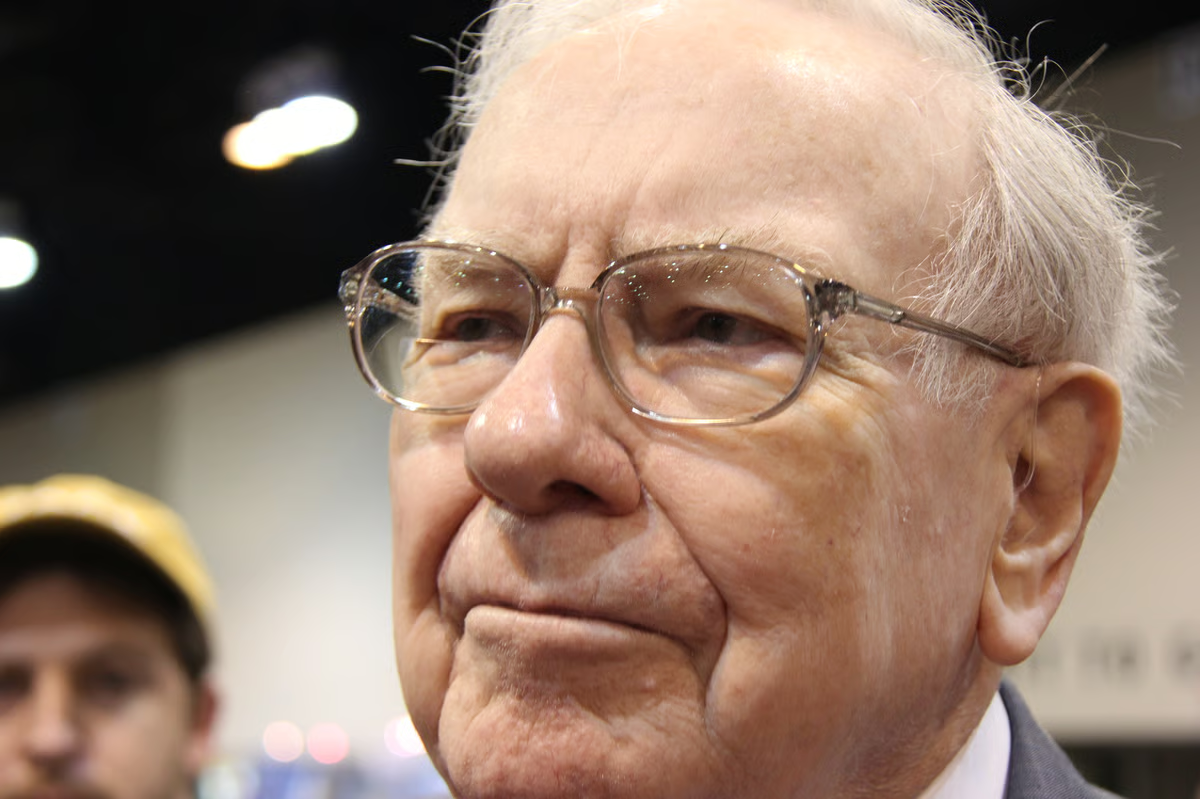
Image source: The Motley Fool.
The $184 billion warning to investors
Buffett has diligently built a massive portfolio of stocks within Berkshire Hathaway, leveraging float from the insurance business he acquired for the conglomerate shortly after taking over as CEO in 1965. Today, the stocks in the portfolio are worth about $315 billion. But they would be worth well over $500 billion if Buffett hadn’t sold so much stock over the last three years.
In fact, Buffett has been a net seller of stocks for Berkshire Hathaway in each of the last 12 quarters, amounting to nearly $184 billion in net sales over the last three years.

Today’s Change
(-0.56%) $-2.81
Current Price
$498.53
Key Data Points
Market Cap
$1.1T
Day’s Range
$496.85 – $501.54
52wk Range
$440.10 – $542.07
Volume
97K
Avg Vol
4.7M
Gross Margin
24.85%
He’s sold some of the portfolio’s biggest positions. For example, he slashed Berkshire’s Apple (AAPL 0.19%) stake by 73%; disposed of 44% of its Bank of America (BAC 0.14%) position; and sold off 26% of the company’s Chevron shares. Dozens of stocks have been culled entirely from the portfolio.
Meanwhile, additions to the portfolio have been relatively small. Most investments involved adding a few hundred million dollars to existing positions. The biggest new positions are Chubb, Alphabet, and Sirius XM. The company also increased its stake in Occidental Petroleum by 36%.
There’s a clear reason for the giant discrepancy between the amounts bought and sold in the portfolio. Valuations in the market have climbed considerably higher over the last few years, particularly among the large-cap stocks held in Berkshire’s portfolio.
Apple, for example, now trades at 33 times forward earnings, a level it has consistently traded at since mid-2024 when Buffett stepped up his sales of the stock. Buffett originally purchased the stock when it traded at a price closer to 10 times forward earnings. Likewise, Bank of America’s price-to-tangible book value ratio is approaching 2, a valuation it’s rarely traded at since the Great Financial Crisis.

Today’s Change
(-0.14%) $-0.08
Current Price
$56.17
Key Data Points
Market Cap
$410B
Day’s Range
$56.02 – $56.55
52wk Range
$33.06 – $56.55
Volume
15M
Avg Vol
36M
Dividend Yield
1.92%
Meanwhile, the entire S&P 500 has seen its valuations rise, with the index trading at roughly 22 times forward earnings expectations, a level rarely seen since the turn of the century. The CAPE ratio touched 40 for the second time in history. And Buffett’s favorite valuation measure, the total market cap as a percentage of GDP (aka the Buffett Indicator), sits well above the 200% level Buffett warned investors about back in the early 2000s.
Investors would be wise to heed the warning Buffett is sending through his actions. Following his playbook could help you keep your head in 2026.
Three things you can do to succeed in 2026
Everyone dreams of Buffett-like success in the stock market, but the reality is that investing like Buffett takes extreme patience to produce excellent long-term results. These three lessons from Buffett can set you up for success in 2026.
1. Don’t be afraid to take gains
Letting your winners run can be a great strategy. As long as your investment thesis hasn’t changed, it can make a lot of sense to continue holding a stock even after a strong performance.
However, allowing a single stock to dominate your portfolio is extremely risky. That risk is amplified if it’s trading at a high valuation. That’s what happened to Berkshire Hathaway, as Apple eventually accounted for half of its marketable equity portfolio. Even after cutting nearly three-quarters of the position, it’s still about 20% of the entire portfolio’s value.

Today’s Change
(-0.19%) $-0.52
Current Price
$273.29
Key Data Points
Market Cap
$4.0T
Day’s Range
$272.86 – $275.37
52wk Range
$169.21 – $288.62
Volume
958K
Avg Vol
46M
Gross Margin
46.91%
Dividend Yield
0.38%
Some investors avoid selling for a gain because they’ll incur a big tax bill. But it’s better to pay taxes and reinvest in a more promising opportunity and greater diversification than to hold a stock you no longer want as much exposure to.
2. Keep some cash on the sidelines
As valuations rise, it makes sense to keep a larger percentage of your portfolio in cash. While Buffett’s cash position is extreme, accounting for over 50% of investable assets, increasing your cash weighting as valuations climb is smart. It can offer some downside protection while positioning your portfolio to take advantage of any market corrections or crashes.
It does come with some opportunity cost, though. Berkshire Hathaway would be worth more today if Buffett hadn’t sold hundreds of billions worth of stock over the last three years. However, those costs can be worthwhile in the long run, as Buffett has demonstrated time and again throughout his investing career.
3. Hold high-conviction stocks
You should hold stocks in your portfolio when you’re confident in the long-term financial performance of the underlying business. Buffett has continued to hold American Express and Coca-Cola since the 1990s. He hasn’t sold a single share in over 30 years. That includes during the dot-com bubble, the great financial crisis, and the current highly valued market. Buffett’s willingness to hold these stocks stems from his conviction that they maintain wide competitive moats and their business prospects aren’t changing.
The better you understand the companies you invest in, what gives them their competitive advantages, and why they’ll continue to grow earnings for years to come, the more likely you’ll be able to hold them amid a downturn in the stock market. That’s key to producing strong long-term returns.