
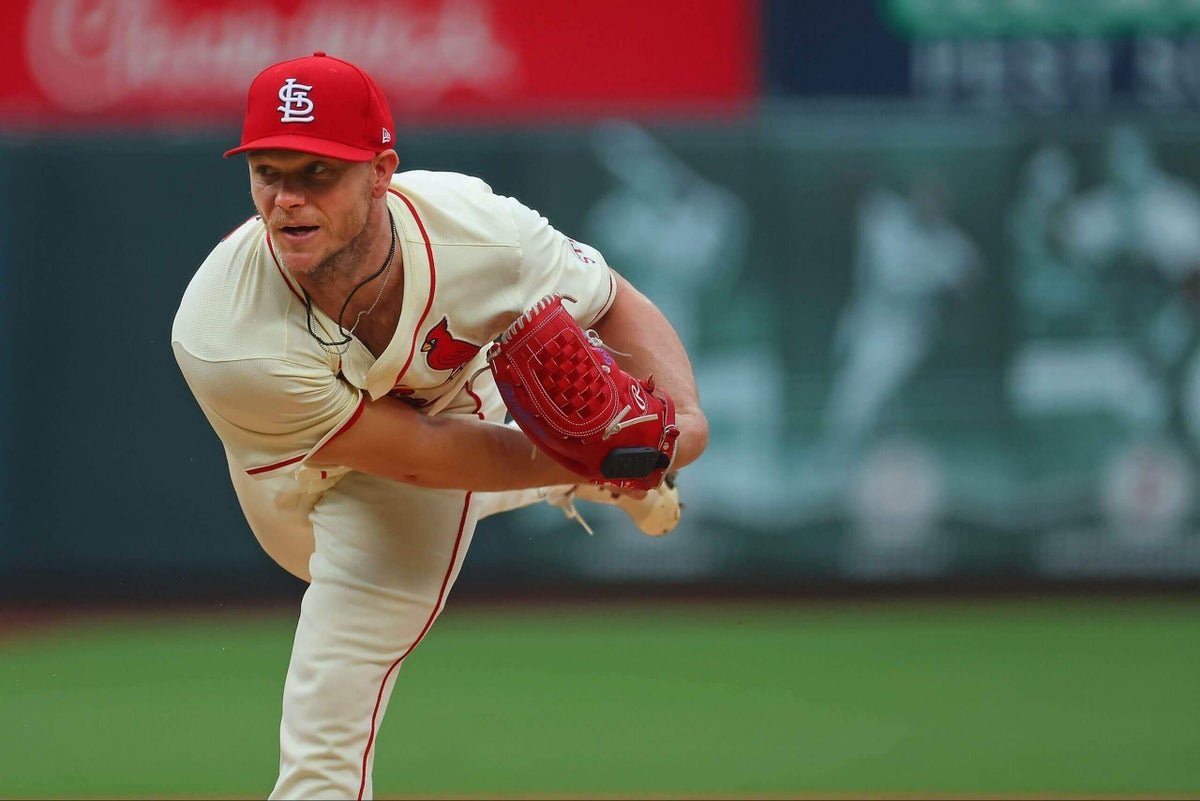
The Boston Red Sox checked off one of their needs this offseason in trading for starter Sonny Gray, but the move should mark just the beginning of what figures to be a busy offseason.
Gray’s arrival does not preclude the Red Sox from adding another starter, one who would slot in front of Gray as a true No. 2 behind Garrett Crochet. But chief baseball officer Craig Breslow acknowledged Tuesday that the focus will likely turn to bolstering the lineup, as the club seeks at least one power bat.
Pete Alonso and Kyle Schwarber remain in the mix, in addition to a reunion with Alex Bregman, but Breslow described free-agent talks with hitters as “still pretty early” on that front, noting free agents are getting a feel for the market.
When asked about where he stands on adding to the rotation, Breslow remained open-minded.
“I don’t want to paint ourselves into a corner here,” he said. “We felt like there was an opportunity to upgrade our rotation in 2026, and we did that. It’s early in the offseason. There are still opportunities that I anticipate materializing. Exactly what they look like, I’m not sure. But we’re not going to close off any chance to make the team better.”
With one major move completed, it’s worth reassessing where things stand for the Red Sox on the payroll front.
Sonny to the Sox.
Welcome to Boston, Sonny Gray! pic.twitter.com/cZ88JDCINy
— Red Sox (@RedSox) November 25, 2025
As part of the trade, the St. Louis Cardinals sent $20 million to Boston in exchange for pitchers Richard Fitts and Brandon Clarke. Gray’s reworked one-year, $41 million contract, as reported by The Athletic’s Ken Rosenthal, only counts as $21 million toward Boston’s luxury tax with the money included by the Cardinals.
With the $21 million accounting for Gray, FanGraphs projects the Red Sox to be on the books for $223 million for luxury tax purposes (which is different from their cash payroll). That puts them roughly $20 million below the first luxury tax threshold of $244 million.
Yet the Red Sox surpassed the luxury tax threshold last season and appear ready to do so for a second straight year, especially considering the current collective bargaining agreement and payroll rules expire after the 2026 season.
If the Red Sox spend between $244 million and $264 million, or $20 million over the first threshold, they will be taxed 30 percent on the overage. If they spend between $264 million and $284 million, they will be taxed an additional 12 percent on that overage. Spending beyond $284 million, or $40 million beyond the luxury tax threshold, also includes a penalty that would push the team’s first MLB Draft pick in 2026 back 10 spots.
Though the Red Sox seem likely to spend beyond the first threshold of $244 million and might consider spending beyond $264 million, it’s highly unlikely they’d hit the $284 million mark, given how much they value the draft and internal development under Breslow.
With all of that in mind, after acquiring Gray, the Red Sox can spend about $20 million with no penalty and close to $60 million more before hitting the draft pick penalty.
This isn’t to say they will do that, but they can. And they’ve at least shown a willingness to go past the first threshold last season.
So, what might they do with that money?
If the Red Sox decide to go all in on a big bat, they will have the money to do so.
The Athletic projects Alonso signing for five years and $140 million; Schwarber for five years, $145 million; and Bregman for six years, $171 million. Each carries an average annual value between $28 million and $29 million.
Alternatively, power-hitting Japanese infielder Kazuma Okamoto is projected to sign for four years, $78.5 million, roughly $19.5 million average annual value.
In turning back to pitching, top starters on the free-agent market remain. Dylan Cease is projected to sign for six years, $174 million, and Framber Valdez is projected for seven years, $196 million — again both falling in the $28 million to $29 million average annual value range.
If the Red Sox wanted to sign one of each, they’d be looking at roughly $60 million in AAV, bumping up against that $284 million threshold.
Boston’s well-stocked farm system, in addition to a group of young outfielders, also gives the Red Sox options to bolster the team on the trade market. In acquiring Gray while only parting with Clarke and Fitts, the Red Sox have kept their system well stocked.
The addition of Gray offers a rotation upgrade. Whether the Red Sox add further to the rotation or allocate significant resources to a free-agent hitter (or two) is unknown. But they’ve set themselves up to make impactful moves this offseason.


