Key events
Record monthly petrol and diesel price increases in March
It’s not just mortgages that are going up, either.
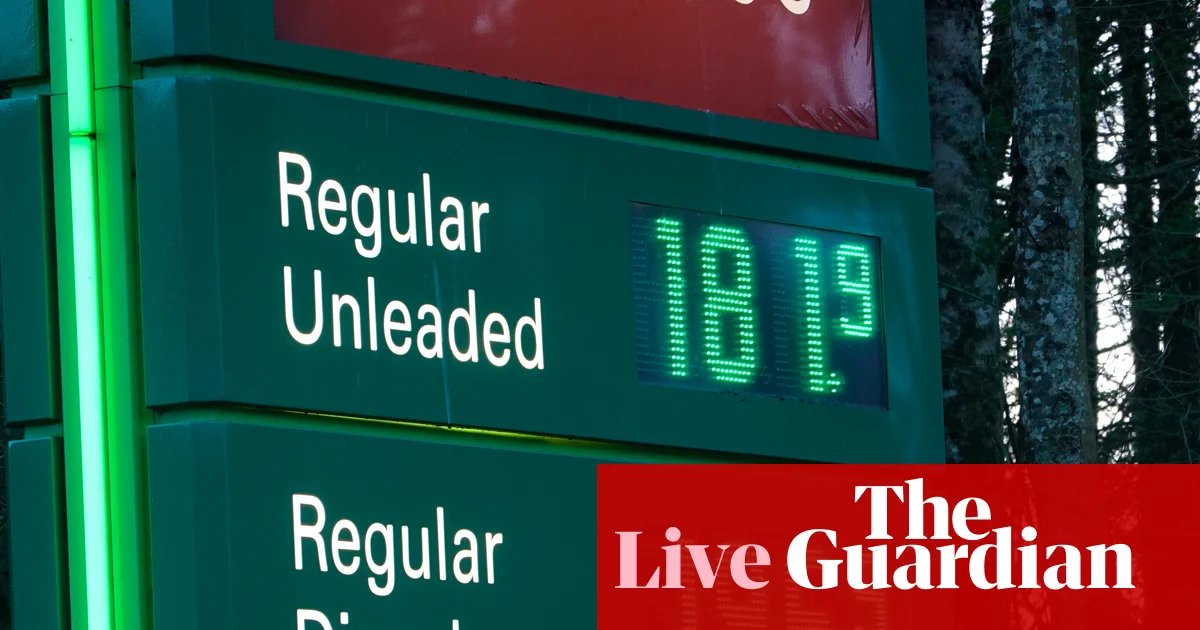
UK petrol and diesel prices jumped by a record amount in March, as the oil supply shock caused by the Iran war quickly rippled to forecourts.
New data from the RAC shows that the average price of a litre of unleaded petrol rose by 20p from 132.83p on 1 March to 152.83p by the end of the month. That surpasses the previous all-time biggest monthly jump of 16.6p recorded in June 2022, following Russia’s invasion of Ukraine.
Diesel prices have risen even more sharply – up 40p in March to an average of 182.77p from 142.38p. That’s almost twice as large as the previous record rise of 22p recorded in March 2022.
RAC head of policy Simon Williams says March’s price rises were ‘unprecedented’, adding:
“The increases drivers have had to endure in March 2026 far exceed those seen in the early days of the war in Ukraine.
“While the monthly rise in a litre of petrol is bad enough, the jump in the cost of diesel is even harder to swallow at 40p a litre.
“With long-term RAC research showing eight-in-10 people are dependent on their vehicles, these costs must really be taking their toll on households as well as businesses.”
However, these record increases are in nominal terms; in real terms, prices rose by more during the oil shock of 1973, the RAC point out.
And despite these price rises, average fuel prices are still below the all-time highs of summer 2022 when petrol peaked at 191.5p per litre and diesel at 199.0p per litre.
Introduction: Iran war brings ‘biggest shock to the UK mortgage market since the mini-Budget’
Good morning, and welcome to our rolling coverage of business, the financial markets and the world economy.
The UK is reeling from the biggest shock to its mortgage market since Liz Truss’s mini-budget in 2022, after the Iran war drove up borrowing costs.
New research from data provider Moneyfacts shows how the cost of fixed-rate mortgages has surged over the last month, making it harder for new borrowers to get onto the housing ladder – and meaning those remortgaging face a surge in repayments.
Here’s the details of how the lending environment has changed since the start of March:
-
Mortgage deals rapidly repriced. Average two-year fixed rates jumped +100 bps in a month (4.84% to 5.84%), with five-year fixes up +79bps (4.96% to 5.75%), marking the sharpest rise since autumn 2022.
-
Product choice contracted. Mortgage availability has fallen by a net 1,283 products (17% of the market) in one month, the steepest contraction by market share since the mini-Budget disruption.
-
Shock for remortgage borrowers. Those rolling off older five-year deals are hardest hit, with rates up 300+ bps and repayments rising by £417–£444 per month (£5k+ annually).
-
Affordability deteriorated quickly. Typical borrowers now face £150 extra per month (+£1,777 annually) on a £250k loan compared to costs at the start of the conflict, with higher LTV borrowers seeing increases of up to £167 per month.
-
Lowest rates moved sharply higher. The cheapest 60% LTV two-year fixed rate has risen +109bps (3.51% to 4.60%), as the most competitive deals have been quickly repriced in response to rising funding costs.
Adam French, head of consumer finance at Moneyfacts, says it adds up too the biggest shock since the aftermath of the mini-Budget three and a half years ago.
French explains:
“Average mortgage rates have risen at pace, with two-year fixes increasing by 100 basis points from 4.84% to 5.84% in just one month and five-year fixes up by nearly 80 basis points, from 4.96% to 5.75%. The cheapest deals available to borrowers have moved dramatically too, the lowest two-year fixed rate at 60% LTV has increased by over 100 basis points from 3.51% to 4.60%. While this falls short of the extreme jumps seen in the aftermath of the mini-Budget, it is still a sharp and sudden shift that has materially worsened affordability in a very short space of time.
“For many borrowers, the cost could be significant. Someone taking out a typical two-year fix will find it costs £150 more per month on average compared to just a few weeks ago. However, the real payment shock will be felt by those coming off older five-year deals, where rates have more than doubled, pushing up repayments by many hundreds of pounds per month.
“The combination of rising rates, reduced choice and heightened volatility means borrowers and brokers are operating in a market where timing is critical and the window to secure competitive deals can be very short-lived. Unfortunately, anyone looking to buy or remortgage this year needs to prepare for substantially higher borrowing costs than expected before this conflict began.”
The City money markets had been reducing their forecasts for how many times the Bank of England might raise interest rates this year to cool inflation, from three hikes to less than two, as of last night.
But, Donald Trump has now disappointed markets by declaring the month-long war in Iran a success which is “nearing completion”, but gave little clarity on how he planned to wind down the conflict over the next “two to three weeks”.
That has knocked Asia-Pacific markets, and pushed up the dollar and the oil price, as hopes of an early end to the conflict fade.