

Joe Raedle / Getty Images News via Getty Images
(Joe Raedle / Getty Images News via Getty Images)
Quick Read
-
Invesco QQQ Trust (QQQ) tracks the Nasdaq-100 index, which is considering a ‘Fast Entry’ provision allowing SpaceX to join after just 15 trading days instead of the standard three-month seasoning period, combined with a 5x float multiplier that would artificially inflate the weighting of stocks with limited public float.
-
Nasdaq is rewriting inclusion rules to accommodate SpaceX’s $1.75 trillion IPO, forcing passive funds to buy billions in shares overnight and creating conditions where insider selling after lock-up periods expire could trigger severe declines in QQQ and similar Nasdaq-100 tracking ETFs.
-
The analyst who called NVIDIA in 2010 just named his top 10 AI stocks. Get them here FREE.
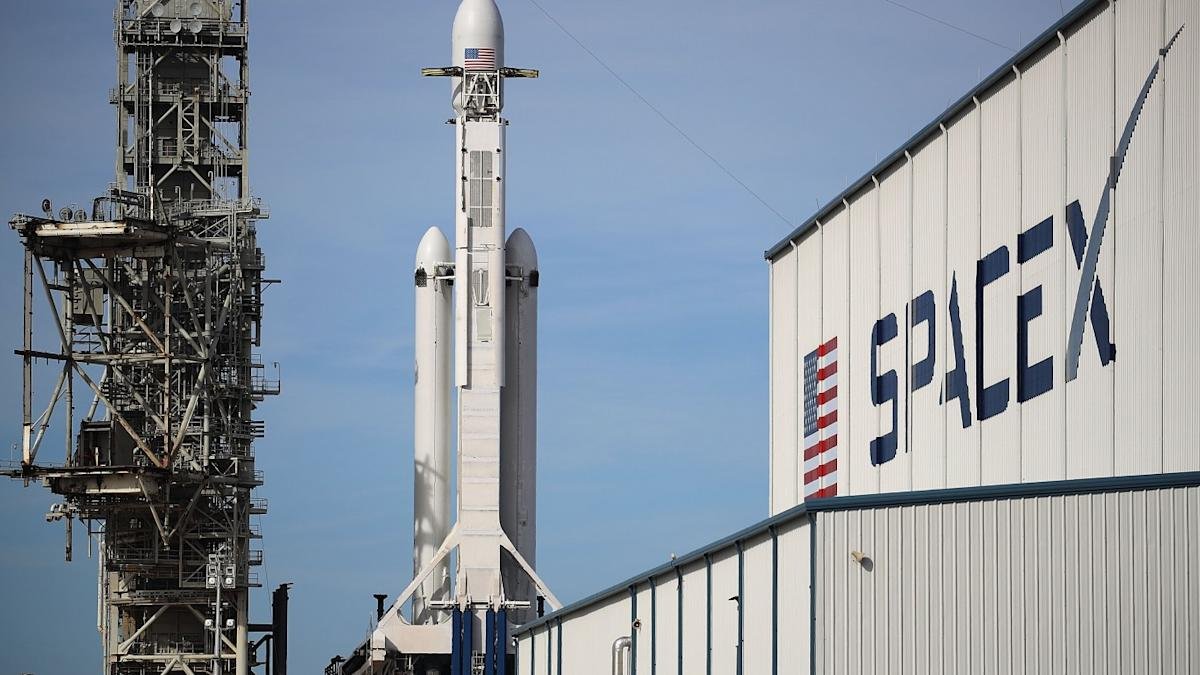
SpaceX is gearing up for what could be the largest IPO in history, with a target valuation north of $1.5 trillion. That would instantly rank it among the U.S.’s top companies and mark a historic milestone for the space sector. Yet the real story isn’t just about rockets and satellites.
The listing threatens to reshape the Nasdaq-100 index in ways never seen before. Nasdaq is considering rewriting its inclusion rules — something SpaceX is pushing for — paving the way for its immediate inclusion.
For the $400 billion-plus Invesco QQQ Trust Series 1 ETF (NASDAQ:QQQ) — and every Nasdaq-100-tracking ETF — this engineered change could inject massive volatility. Investors just might want to sell before the IPO to avoid being caught in the crossfire.
READ: The analyst who called NVIDIA in 2010 just named his top 10 AI stocks
Nasdaq Wants to Rewrite the Rulebook
There has been growing discussion that to accommodate the giant IPO, Nasdaq has proposed a “Fast Entry” provision. Any newly public company whose market cap lands in the top 40 of current Nasdaq-100 constituents could join the index after just 15 trading days — no three-month “seasoning period”, no liquidity tests, no waiting. Other exchanges, including big index provider FTSE Russell, are also considering making similar changes
According to Reuters, SpaceX has reportedly made rapid inclusion a necessary condition of listing on the exchange. While adding a $1.75 trillion behemoth sounds bullish for the index on paper, the mechanics reveal potential problems. Passive funds tracking the Nasdaq-100 would be forced to buy billions in shares almost overnight, regardless of market conditions or price discovery.
The 5x Float Multiplier Trap
Compounding the issue is a new weighting twist: the 5x float multiplier. Under the Nasdaq-100 proposal being considered, stocks with less than 20% of shares available to the public get weighted at five times their actual float percentage. If SpaceX floats only 5% of its shares at a $1.75 trillion valuation, passive vehicles would treat it as if $437 billion in stock existed — even though the real tradable float is just $87 billion. Invesco QQQ and similar ETFs would have no choice but to chase the price higher to match the index. That artificial demand creates a short-term surge, inflating the stock far beyond what organic buyers would support.
The real risk would surface months later. Once lock-up periods expire — typically within 90 to 180 days — insiders and early investors holding the vast majority of shares could then sell into the inflated passive bid. The same mechanism that drove the surge becomes the exit ramp.
When selling pressure hits a paper-thin float, the stock could plummet. Because QQQ mirrors the Nasdaq-100 exactly, the ETF would follow suit, dragging retirement portfolios down with it. What looks like a one-time boost for the index could instead transfer wealth from passive investors to company insiders, leaving 401(k) holders holding the bag.
Key Takeaway
This isn’t a SpaceX-only carve-out. Nasdaq’s rule changes would likely apply to other massive tech IPOs on the horizon, including OpenAI and Anthropic. These AI giants are also staying private longer thanks to abundant venture capital and plan similar low-float structures following their IPO. The precedent set here could open the floodgates for multiple high-valuation entrants with minimal public shares, amplifying the same passive-inflow-then-insider-sell dynamic across the Nasdaq-100.
So, should you consider selling QQQ before the big IPO? It might not be a bad idea. The short-term index boost is tempting, but the structural risks — manipulated weighting, zero seasoning, and insider exit liquidity — are too severe to ignore.
Trimming or outright selling your Invesco QQQ exposure ahead of the SpaceX listing makes sense. While opening the stock to deeper liquidity could minimize the market impact of any insider exodus after lockup periods expire, once the rules lock in and passive buying begins, the downside asymmetry becomes clear: you aren’t just investing in SpaceX, but also balancing against the risk that an extended and sustained downturn wipes away significant value from your retirement account.
The analyst who called NVIDIA in 2010 just named his top 10 AI stocks
Wall Street is pouring billions into AI, but most investors are buying the wrong stocks. The analyst who first identified NVIDIA as a buy back in 2010 — before its 28,000% run — has just pinpointed 10 new AI companies he believes could deliver outsized returns from here. One dominates a $100 billion equipment market. Another is solving the single biggest bottleneck holding back AI data centers. A third is a pure-play on an optical networking market set to quadruple. Most investors haven’t heard of half these names. Get the free list of all 10 stocks here.