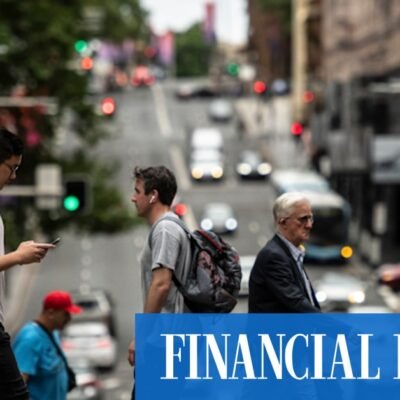

“Dear Lord … I pray for my stock to rise so that I become wealthy beyond my wildest dreams … oh, and for world peace, too … Amen.” Pic: Getty Images
Many of Australia’s wealthiest investors are also among the most patient, shunning trying to time market moves and instead embracing the power of compounding returns over years and decades.
Whether through shares or property, successful investors avoid chasing quick gains and shrug aside being pressured by modern society to focus on immediacy, investment specialists say.
A new analysis by Betashares Direct has found that the wealthiest investors trade 60 per cent less than people with less wealth, and share investors who tried to time the market last year were potentially big losers.
It examined S&P/ASX 200 market moves and found that share traders who missed the market’s best 10 days of 2025 would have been 17 per cent worse off than those who simply held a portfolio from January 1 to December 31.
The traders would have suffered a negative 6.95 per cent return for the year, compared with 10 per cent-plus returns for the patient investors, Betashares Direct head of product Matthew Fish said.
He said attempting to time the market was “an extremely tall order that even professional investors regularly fail to consistently get right”.
“Over the longer term, investors are often better off taking advantage of the natural compounding power of the market by holding a diversified portfolio that meets their long-term wealth goals,” Mr Fish said.
This strategy had psychological benefits by removing the temptation to trade based on the negative emotions of fear and greed.
“Patience in many respects is the most powerful tool in any investor’s toolkit, not just those with larger portfolios,” he said.
Mr Fish said investors could build patience by setting long-term objectives, building a diversified portfolio, and automating their investing through dollar-cost averaging to reduce emotional decision-making.
Tribeca Financial head of advice Robert Devlin said patience was crucial.
“The magic in investing comes over the long term through compounding returns,” he said.
“Some years will be great, some years will be poor. What we know, and have experienced, is the longer you are invested and the more patient you are, the better the outcomes.”
Mr Devlin said most of his firm’s wealthiest clients built up their money over decades rather than months or years.
“They nearly all have stories of bad periods and challenges they faced. The commonality is they stayed the course in those tough times and kept to their plan,” he said.
“New investors can read and study market swings but I’ve generally found you’ve got to live a few first-hand before the power of patience and riding out the downturns really hits home.”
Mr Devlin suggested setting long-term aspirational and challenging goals, which “gives you a north star to work towards”.
“Don’t check your investments every day,” he said.
“There is a trap in getting caught up in the daily or weekly fluctuations in the market. Our brains naturally place more weight on a losing day than a winning (one), so even if we are ahead we may start to feel anxious or impatient with our investments if looking at them too often.”
Understanding how compounding interest works is important, Mr Devlin said, because the first few years could feel slow and arduous. “Run a calculator to see what the power of compounding interests looks like in five or six years if you stick to your plan, and you’ll be surprised how much better it gets quickly,” he said.
Property investors should practise patience too, because real estate values can suffer downturns lasting several years before booming again during their next cycle.
Metropole Property Strategists founder Michael Yardney said building wealth through property was mostly a game of time, and the best investors positioned themselves for compounding to do the heavy lifting over the next 20 years.
“Most people want the reward of investing without the waiting,” he said.
“A lot of investors today are chasing a quick hit, fuelled by social media, flashy promises and a whole new class of gurus claiming you can make a killing in property before Christmas.
“The wealthiest investors I’ve dealt with think in decades, not days. They don’t obsess over what interest rates will do in six weeks or six months.”
Instead, wealthy investors asked what a property would be worth in 10, 15 or 20 years, Mr Yardney said.
He said median dwelling values in Australia had averaged 6.8 per cent annual growth over the past 40 years.
“Property is a long-duration asset that grows through cycles, not in straight lines. If you’re looking for fast gratification, property is the wrong game. But if you can hold quality assets through the noise, property becomes a compounding machine,” he said.
Mr Yardney said there had been a “cultural drift towards immediacy”.
“Social media has shortened everyone’s time horizon. ‘Here’s how to get rich slowly over 20 years’ doesn’t go viral. On the other hand, ‘Buy in this boom suburb now’ does.
“That creates a market in which people believe that investment success arises from constant action rather than from consistent ownership of high-quality assets.
“Patience isn’t being passive. It’s a disciplined commitment to a long-term plan, executed with high-quality asset selection and a buffer against life’s surprises.”
This article first appeared in The Australian as How the wealthiest investors build their fortunes with one simple strategy