
Lucid Group (LCID +0.00%), a maker of luxury electric vehicles (EVs), will execute its 1-for-10 reverse stock split after the market close on Aug. 29. That means every 10 shares of Lucid, which currently trade at about $2 each, will be swapped for one share at around $20.
That’s why Lucid’s stock price will jump 900% when the market opens again on Sept. 2. Let’s see what that reverse split might mean for its investors.

Image source: Lucid.
A reverse stock split is generally a red flag
Most investors are likely more familiar with forward stock splits, which split a high-flying stock into more affordable slices. For example, when Tesla (TSLA 0.01%) executed its first 5-for-1 stock split in August 2020, its trading price dropped from roughly $2,200 to around $440. After Tesla’s stock price more than doubled to about $900 in August 2022, it reduced its stock price to about $300 with another 3-for-1 split.
Those forward stock splits didn’t alter Tesla’s market cap or valuations, but they made it easier for smaller retail investors to buy a round lot (100 shares) of its stock. That made it cheaper to trade options (since a single contract is tethered to a round lot), gave it more ways to pay its stock-based compensation, and boosted the stock’s liquidity.
A forward stock split is also a bullish signal because it’s usually executed when a stock is rising. A reverse stock split is a bearish one because it’s executed when a stock is dropping, and it’s usually only done to keep a stock’s price above $1. If a stock drops below $1 for an extended period, it could be delisted from whatever exchange it is trading on (in Lucid’s case, it’s the Nasdaq). Therefore, Lucid’s reverse stock split should protect it from being delisted for the foreseeable future, but it won’t resolve its underlying problems.
What are Lucid’s underlying problems?
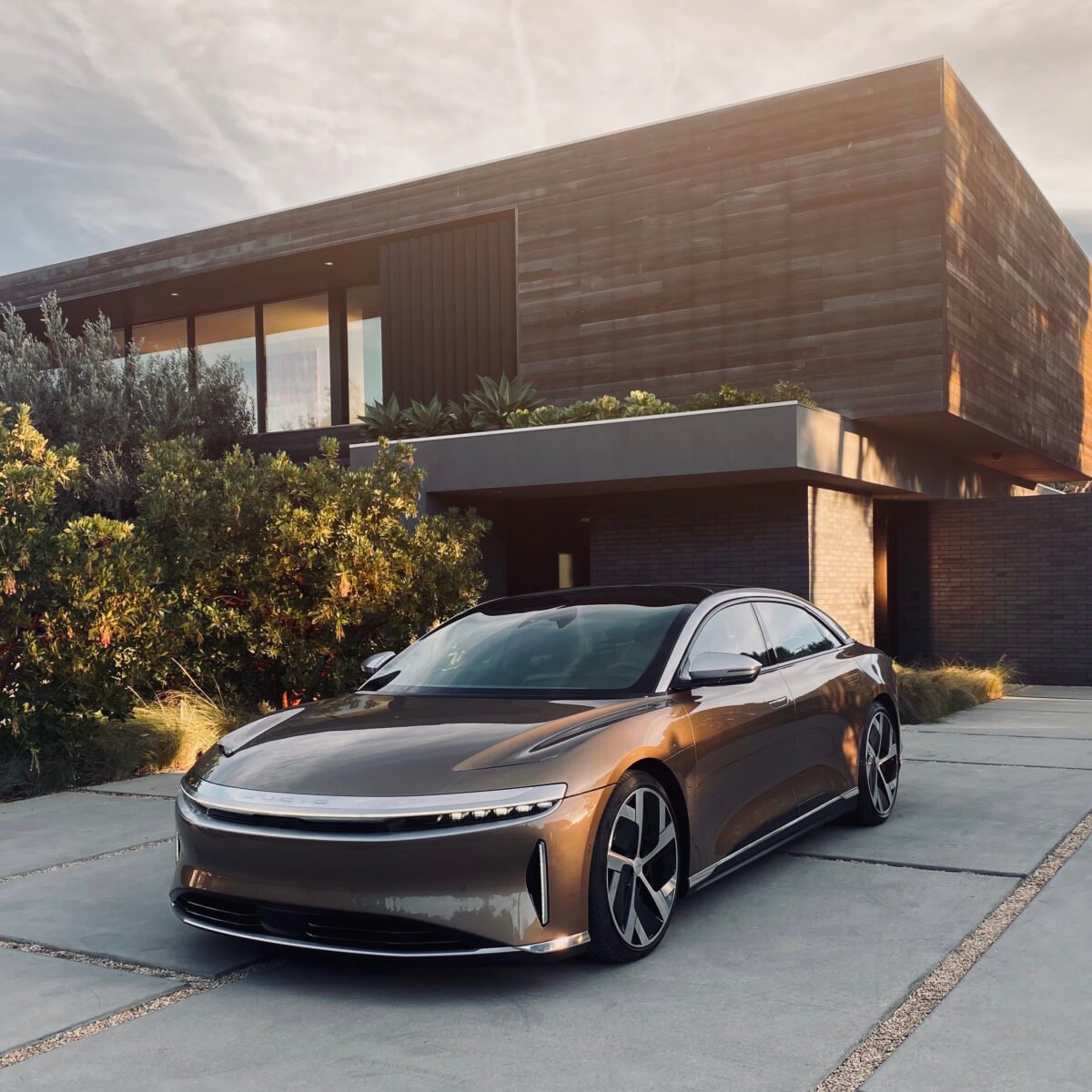
When Lucid went public by merging with a special purpose acquisition company (SPAC) four years ago, it attracted a lot of attention because it was led by Peter Rawlinson, Tesla’s former chief vehicle engineer (he developed Tesla’s Model S). Lucid positioned its first vehicle, the Air sedan, as a pricier but more luxury-oriented rival for the Model S.
Prior to its public debut, Lucid claimed it could deliver 20,000 vehicles in 2022, 49,000 vehicles in 2023, and 90,000 vehicles in 2024. Unfortunately, it only delivered 4,369 vehicles in 2022, 6,001 vehicles in 2023, and 10,241 vehicles in 2024. It also postponed the launch of its second vehicle, the Gravity SUV, from 2024 to 2025. Rawlinson stepped down from his CEO and chief technology officer roles this February, and Lucid’s board still hasn’t appointed a permanent successor yet.
Lucid struggled with supply chain constraints, intense competition, and macro headwinds for the broader EV market. But it’s still firmly backed by Saudi Arabia’s Public Investment Fund (PIF), which owns more than 60% of its shares, and it claims it has adequate liquidity ($4.86 billion) to ramp up its production of the Gravity SUV. It’s also been expanding its AMP-1 plant in Arizona and its new AMP-2 plant in Saudi Arabia to support that growth.
But Lucid could be running out of time. In 2024, its revenue rose 36% to $808 million, but its net loss widened from $2.8 billion to $3.1 billion. That means it’s still losing a staggering $299,000 for each vehicle it sells. Lucid already reduced the price of the Air multiple times over the past four years (from a starting price of $80,000 to around $71,400 today) to stay competitive, so it can’t simply raise its prices to pass its high manufacturing costs onto its customers.
What are Lucid’s near-term plans?
For 2025, Lucid aims to produce 18,000 to 20,000 vehicles as it keeps selling Air sedans and delivers more Gravity SUVs. In 2026, it plans to launch a more affordable SUV (which might be called Earth) to keep pace with Tesla and other EV makers. If it successfully executes those plans, analysts expect its revenue to surge 61% to $1.3 billion in 2025 and jump another 90% to $2.5 billion in 2026. They also expect it to narrow its net loss to $2.8 billion in 2025 and $2.4 billion in 2026.
That progress could bring back the bulls, but Lucid is still tiny compared to Tesla, which delivered 1.79 million vehicles and generated $97.7 billion in revenue in 2024. With a market cap of $6.4 billion, Lucid trades at 5 times this year’s sales. Tesla, which is worth $1.13 trillion, trades at 12 times this year’s sales.
So if Lucid gets its act together, its stock could double or triple if it commands a similar price-to-sales ratio as Tesla. Lucid’s reverse stock split might buy it more time for those plans to bear fruit, but it doesn’t make it a more attractive investment. So for now, I’d avoid this volatile EV stock until a few more green shoots appear.


