

This change in behaviour is visible in the numbers. Though many small investors had been actively buying during the Sensex’s nearly 7% rise in the December quarter, positioning for a possible policy boost, their participation has since narrowed.
Budget Day impact
Out of 2,321 companies analyzed by Mint, only 967 firms or 42% saw an increase in ownership by small retail investors (those holding shares worth up to ₹2 lakh) during the December 2025 quarter. This was down from 48% in the September 2025 quarter and marked the lowest level since December 2021.
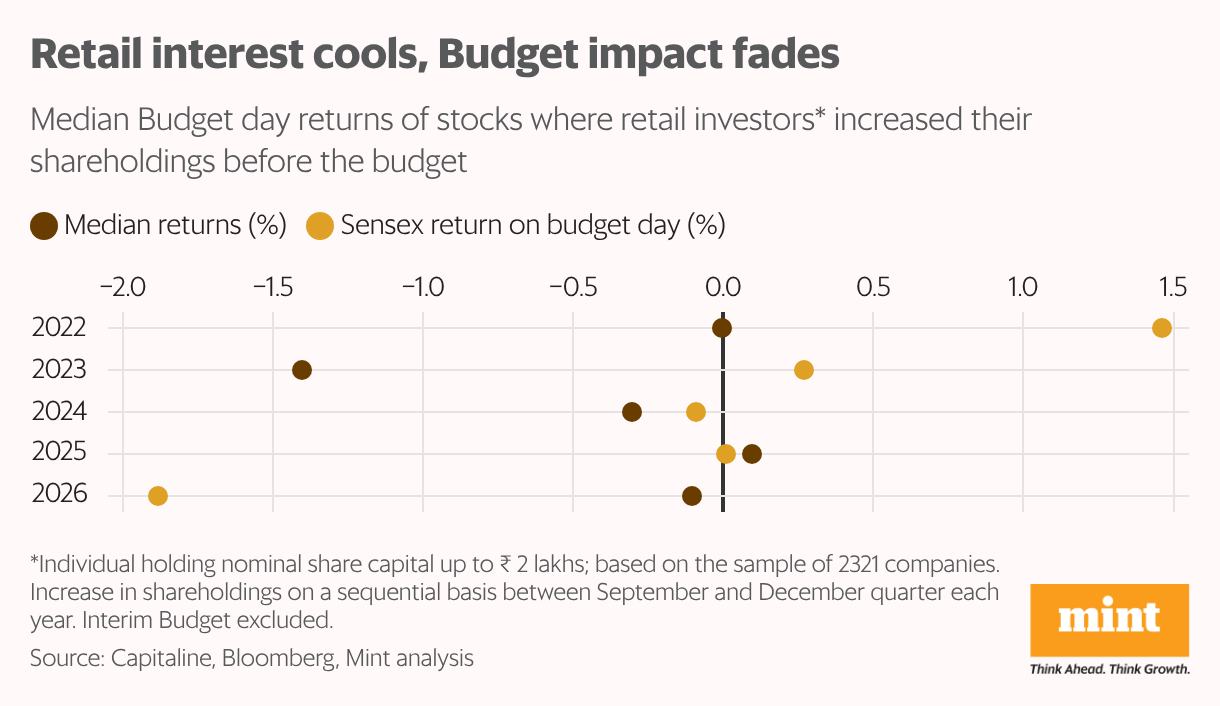
The median return on Budget Day 2026 for stocks where retail shareholding had increased sequentially between September and December 2025 was just -0.14%, even as the Sensex dropped nearly 2%, its steepest single-day drop since 2020.
The trend is not new. In 2025, retail-favoured stocks rose just 0.1% on Budget Day while the BSE Sensex was flat. In 2024, these stocks fell 0.3% while the index was nearly unchanged, and in 2023 they dropped 1.4% even as the index gained 0.3%.
‘Investors turning more selective’
In sharp contrast to previous years, retail investors were net sellers ahead of Budget 2026. About 55% of companies saw retail shareholding fall, the highest level since 2021.
“The headline numbers may look uncomfortable, but they don’t mean retail investors are abandoning equities,” said Akshat Garg, head of research and product at Choice Wealth. After years of rapid expansion in market participation, investors are becoming more selective, he said. Rather than spreading money across a wide range of stocks in the hope of a Budget-led rally, flows are increasingly gravitating towards mutual funds and SIPs, or into a narrower set of high-conviction ideas. This signals maturing behaviour, not risk aversion, Garg said.
The diminishing impact of Budget Day reinforces this shift. Market expectations are now debated and priced in weeks in advance, and by the time the finance minister speaks, most tradeable information is already embedded in stock prices. Garg added that near-term market moves are driven far more by global liquidity, foreign investor flows, interest-rate expectations and earnings visibility than by Budget announcements.
Vinayak Magotra, product head and founding team member at Centricity WealthTech, said the caution seen in the December quarter reflected weaker sentiment, geopolitical risks and commodity volatility. Budgets now provide mainly short-term sentiment triggers, which have little bearing on medium- to long-term equity returns, Magotra said, adding that pushes individual investors to be more selective and deliberate.
Noisy signal
Retail participation in Q3 was not only thinner but also directionally noisy. Across most large sectors, the Budget-day performance of stocks to which retail investors increased exposure was no better than those in which they cut their positions.
The finance sector best illustrated this churn. Only 38% of finance stocks saw higher retail ownership, while 58% saw reductions. Yet Budget-day returns were marginally positive in both cases.
Pharmaceuticals and chemicals followed a similar pattern: retail investors trimmed holdings in 62% of chemical stocks and 55% of pharma stocks, but returns remained muted regardless of buying or selling.
There were a few exceptions to this. Among software companies, higher retail participation in 46% of stocks coincided with stronger Budget-day returns. Textiles also stood out, with stocks that had rising retail ownership outperforming those in which positions were trimmed.
The broader signal, however, is clear. Retail investors are no longer crowding into sectors ahead of the Budget. Participation has become narrower and more selective – and an increasingly unreliable directional cue.
Retail crowding didn’t protect stocks
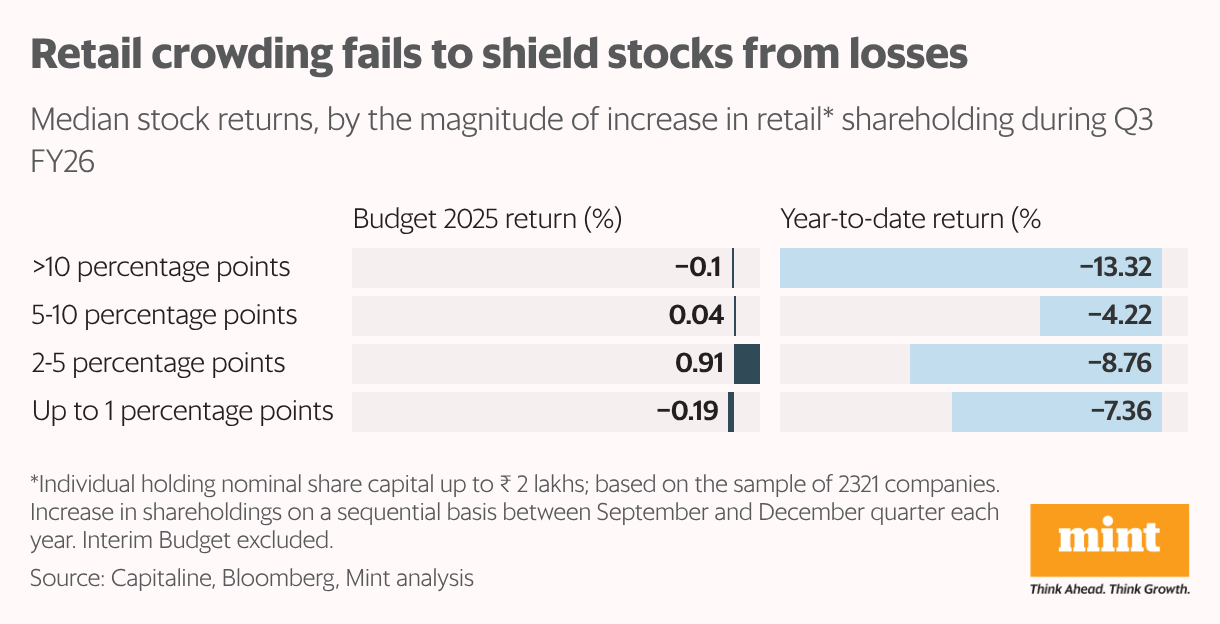
Performance trends also help explain the caution. Heavy retail buying in the run-up to Budget Day did not protect stocks from broader weakness.
- Companies in which retail ownership rose by more than 10 percentage points between Q2FY26 and Q3FY26 posted a median loss of 0.1% on Budget Day and remained down so far this year, with a median return of -13.3%.
- Stocks with a 5-10 percentage point rise in retail holding were flat 0.04% on the day and down 4.2% this year.
- Those with a 2-5 percentage point increase gained 1% on the day but have fallen 8.7% so far this year.
- Even stocks with only a small rise in retail ownership are down around 7% this year.
Long-term reforms may matter more
Experts said structural reforms would matter more over the long term than one-day market reactions. Mahavir Lunawat, chairman and managing director of Pantomath Capital, pointed to measures such as market-making in corporate bonds, total return swaps and faster, more digital settlement systems as steps that could deepen and strengthen market infrastructure.
“From a medium- to long-term perspective, this is a good Budget that lays out a clear strategy for growth with fiscal prudence,” said Dr. V. K. Vijayakumar, chief investment strategist at Geojit Investments. He expects nominal GDP growth of around 10% in FY27, which could translate to corporate earnings growth of about 15%, supporting equities over the medium term.
He noted, however, that this year’s Budget was mildly disappointing for the stock market as it did not deliver the expected relief on capital gains tax.