This article is an on-site version of our Moral Money newsletter. Premium subscribers can sign up here to get the newsletter delivered twice a week. Standard subscribers can upgrade to Premium here, or explore all FT newsletters.
Visit our Moral Money hub for all the latest ESG news, opinion and analysis from around the FT
Welcome back. The temperature at COP30 was already high enough before the fire that broke out in the venue yesterday, forcing the rapid evacuation of thousands of delegates. More than a dozen people required treatment for smoke inhalation.
But the venue is open again this morning, in time for what’s likely to be a day of fierce debate over the latest draft agreement that dropped in the small hours.
If recent COPs are any guide, these discussions are likely to drag on well into the weekend. To stay on top of the latest developments, make sure to follow the COP30 topic on myFT.
COP30
The final stretch
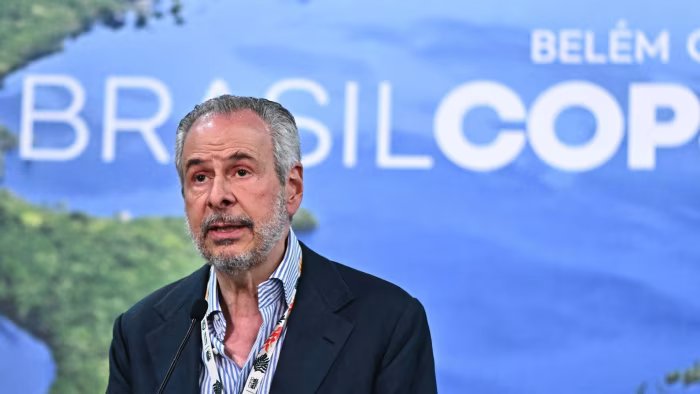
Is COP30 president André Corrêa do Lago trying to steamroller through a weak agreement — or playing a subtle game of three-dimensional diplomatic chess, which could lead to a much stronger outcome?
At 3 o’clock this morning in Belém, after a day severely disrupted by the evacuation of the COP venue, the Brazilian presidency published a new draft summit agreement that will have satisfied no one.
Prior drafts released earlier in the week had included various options for language supporting strengthened global action and planning around a transition away from fossil fuels. That would have put more meat on the bones of an agreement on this principle at Dubai’s COP28 two years ago. The push for such a “road map” in Belém was galvanised when it received a surprise endorsement on the eve of the summit from Brazilian President Luis Inácio Lula da Silva.
This morning’s text includes no reference at all to such an initiative. Indeed, it doesn’t mention fossil fuels at all — not even a call for reducing “inefficient” subsidies for them, which appeared in previous COP agreements and in earlier drafts of this text.
Even before the text was formally published, it was criticised in a letter to the COP presidency signed by more than 30 countries that have been pushing in Belém for a fossil fuel transition road map.
“In its present form, the proposal does not meet the minimum conditions required for a credible COP outcome,” the letter warned. “We cannot support an outcome that does not include a road map for implementing a just, orderly and equitable transition away from fossil fuels.”

Signatories to the letter included Colombia (which has been at the centre of the road map push) and climate-vulnerable developing nations from Kenya to Honduras to Vanuatu. But the best-represented continent was Europe, with most of its biggest economies backing the letter of complaint.
That fits with Europe’s stance in Belém, as at other recent COPs, on the need for an accelerated move away from fossil fuels. “A strong energy-transition road map is essential, including a clear path away from fossil fuels,” said EU climate commissioner Wopke Hoekstra this week.
Yet European and other developed nations are accused by critics of working to slow progress on another burning issue at COP30: international climate finance.
The principle that wealthy nations should financially support green investment in poorer ones — mainly because they’ve used up a disproportionate share of the world’s “carbon budget”, and got rich while doing so — has been core to the climate COP process since its inception in 1992. Last year at COP29 in Baku, rich countries agreed to “take the lead” in mobilising $300bn a year by 2035 for climate action in developing nations.
This year in Belém, developing countries have pushed for stronger processes to ensure that this goal is delivered. They also pushed for a new commitment from rich nations to triple adaptation finance to an annual $120bn by 2030.
The focus on adaptation finance reflects rising concerns about the economic risks of severe weather events. But it’s been resisted by European and other wealthy nations. Finance for climate adaptation measures (like sea walls) tends to offer lower returns than finance for climate mitigation (like solar farms), and is correspondingly more expensive for the provider.
The language in this morning’s text was much weaker than developing countries have been pushing for: it “calls for” efforts to triple adaptation finance by 2030, rather than setting a formal goal. Suggested language in the previous draft for talks on “unilateral trade measures” — reflecting concerns among developing nations about the EU’s new carbon border levy system — has also been removed.
The stage is set, then, for some intense last-minute manoeuvring. If the EU and other developed nations are truly set on a road map from fossil fuels, they may need to go further on climate finance, and at least show openness to discussion on the trade issue. Should the Brazilians get the vast majority of parties on board with a revised agreement along these lines, big oil producers such as Saudi Arabia may find themselves too isolated to block it.
That’s one theory for how things could develop from here. But only the most starry-eyed optimist would bet on a swift resolution of these talks. This may be the last day of the official summit schedule, but COP veterans are bracing for a tough weekend.
Smart reads
Pointing the finger UN secretary-general António Guterres identified Saudi Arabia as leading moves to obstruct key outcomes at COP30, according to people present at meetings with EU negotiators.
Agenda setting Donald Trump agreed to attend next year’s World Economic Forum in Davos after organisers assured him that overtly “woke” topics would not feature prominently at the gathering, the FT reported.