
[ad_1]
Australia’s housing market could be heading toward one of its most dramatic corrections in decades after the federal budget’s negative gearing and capital gains tax overhaul.
Finance experts have been weighing in all week following the Labor government’s polarising strategy to hit investors with a generational shift to capital gains tax discounts.
Analysts from investment bank Morgan Stanley have now made the incredible call that house prices could fall between five and 10 per cent as the tax changes dramatically alter the economics of property investment and slash borrowing power for new investors.
“Proposed tax changes to capital gains and negative gearing announced in the federal budget last week fundamentally change the asset allocation decision for Australian households,” Morgan Stanley chief economist Chris Read said.
“This is particularly the case for housing: the previous model of high leverage, cash flow losses, and large expected capital gains is meaningfully challenged.”
The bank warned investors, who make up roughly one-third of marginal housing demand, may retreat from the established housing market in droves as returns weaken.
Rather than rents simply rising to absorb the changes, Morgan Stanley expects housing prices to take the brunt of the hit.
EXPLAINER:What negative gearing, CGT changes mean
“We estimate that a 15-20 per cent decline would be required to fully restore investor economics,” the bank said.
It ultimately forecasts a smaller but still severe national correction of between 5 and 10 per cent, which it described as “one of the largest price corrections over the past 40 years”.
The warning lands amid already weakening housing conditions, with softer auction clearance rates, elevated interest rates and broader global uncertainty tied to the Middle East conflict all weighing on sentiment.
Morgan Stanley said the fallout could spread far beyond property itself.
“A weaker housing market will drive a broader economic slowdown, with policy implications,” the bank concluded, warning of downside risks for banks, developers, consumer spending and digital real-estate businesses.
The bank also suggested the housing slowdown could keep the Reserve Bank of Australia on hold through the rest of 2026 as weaker prices flow through to household spending and the labour market.
The analysis adds to mounting backlash from property investors, business groups and sections of the technology sector following Labor’s sweeping budget changes, which restrict negative gearing to new builds and impose tougher capital gains tax treatment on future investments.
Flat for a year, then decline
HSBC Chief Economist Paul Bloxham predicts home values will remain flat in 2026, followed by a national decline of 3 to 6 per cent next year.
“We think house prices will fall outright in the second half of this year,” Mr Bloxham told news.com.au.
“We had quite a bit of positive momentum through the first part of the year, but we think we’re going to lose that in the second half, and that will leave you with flat house prices this year. And then with that decline running into next year as well.”
MORE: ‘Who cares?’ – $60m landlord on negative gearing change
It comes as the Reserve Bank of Australia (RBA) has made consecutive 25-basis-point hikes in February, March, and May, bringing the official cash rate to 4.35 per cent, with financial markets pricing in at least one more hike as inflation remains stubbornly high.
“The inflation challenge Australia faces at the moment means interest rates are likely to have to stay elevated for an extended period, and so if they stay higher for longer, we think that will put more downward pressure on house prices,” Mr Bloxham said.
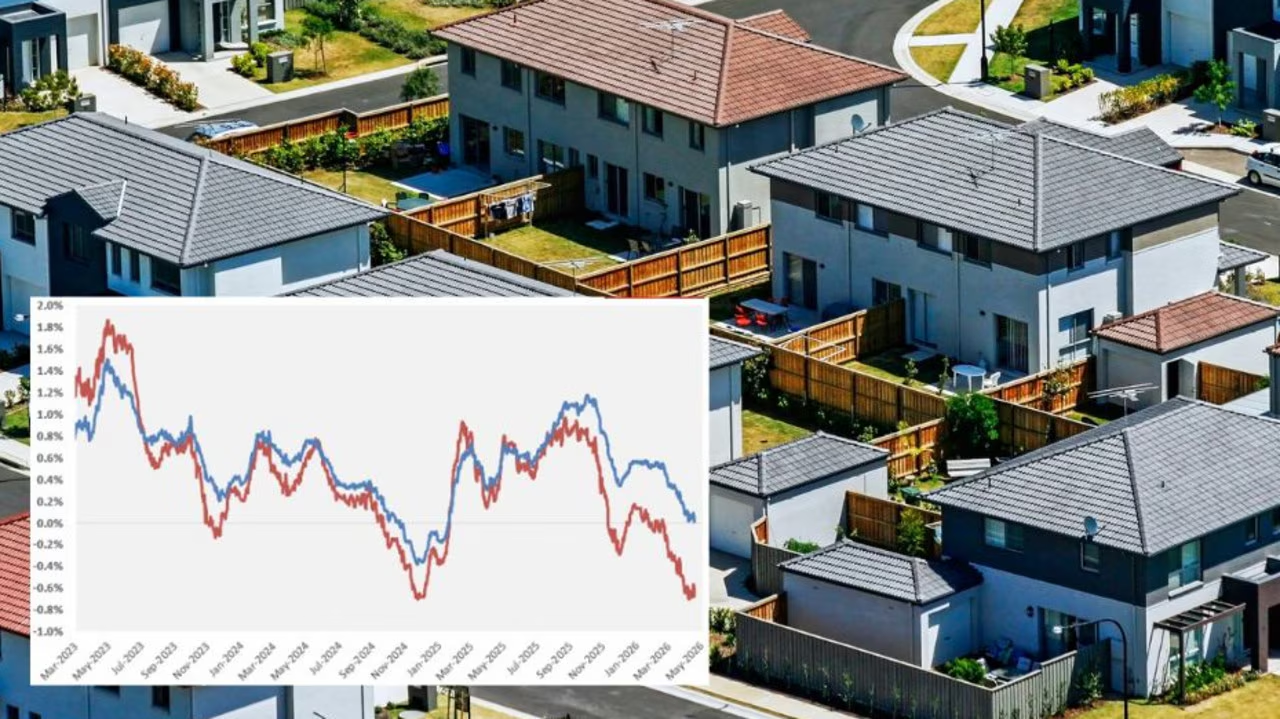
The economist said prices in Sydney and Melbourne had already been falling for a few months, while investors had helped to maintain house price growth in smaller cities like Perth and Brisbane.
Reforms in the federal budget, which removed negative gearing and the 50 per cent capital gains tax (CGT) discount for established properties, would now cause investors to “pull back, cooling those housing markets as well,” he argued.
AMP Chief Economist Shane Oliver also believed home values could start falling within the next six months.
“National house price growth has slowed to about 0.3 per cent a month, and I suspect it will probably slow further from here and possibly go negative, because the after-tax return to investors as a result of the tax changes will have fallen, which will steer investors off,” Mr Oliver told news.com.au.
“And then you combine that with the rate hikes and economic uncertainty associated with the Iran war. It points to property prices falling.
“Nationally, we could dip into negative territory sometime in the next six months. I suspect Sydney and Melbourne will probably weaken further from here — they’ve already gone negative.”
Mr Oliver said the market outlook was “reasonably good” for first-home buyers, who would now face less competition from investors.
“Higher interest rates still have a negative impact, because it reduces the amount of money you can borrow, so you’ve still got a dampener there.
“But for those who are looking to get in, and already have the financing lined up, then it’s not a bad time — it’s probably a good time.”
Mr Oliver said last week’s federal budget had reinforced his view that there would be one further interest rate hike in August.
“Obviously there’s the risk there could be more, given the size of the inflation problem.”
Other banks have more moderate national house price forecasts and are not tipping values to turn negative, although they have revised their expectations down.
Commonwealth Bank forecasts national dwelling prices will grow by 3 per cent over 2026 and another 3 per cent in 2027, a downgrade from its previous forecast of 5 per cent growth next year.
ANZ is predicting home prices in the capital cities to notch up 2.8 per cent growth this year, down from an earlier forecast of 4.8 per cent, and 2.1 per cent in 2027.
“We have a weaker outlook for the economy more generally than the consensus at the moment,” Mr Bloxham said when asked why his outlook differed from those of the other banks.
“We think the economy’s going to tip into a bigger downturn, and we think that’s happening sooner as well.”
The economist said he had given more weight to sharp declines in business and consumer confidence in recent months.
“And so I think we’re reading more into that and saying that the economy’s going to weaken a bit more quickly than the consensus, and that that’s going to then feed into weakening the housing market as well.”
He was not forecasting a recession – defined as two consecutive quarters of negative GDP growth – but he expected a rise in unemployment rate to 5 per cent by mid-2027, a bigger increase than that forecast by the RBA or Treasury.
“What I would say with confidence is the economy is going to have a downturn, and in this particular spot I would say we have to have a downturn.
“There’s no other way to get inflation to come down.”
In Sydney, Cotality figures showed auction clearance rates at the weekend plummeted 6 per cent to 49.2 per cent, the worst outcome since Covid disrupted auction results in April 2020.
House prices in Sydney have also been falling since February, dropping 0.6 per cent in April alone.
[ad_2]
Source link