
[ad_1]
Leaves look organic. The veins inside them seem to branch and spread at random, shaped by growth and chance. That natural irregularity is part of what makes them beautiful.
The Chinese money plant turns out to be an exception. Its veins are not random – they follow precise geometry, the kind used in city planning. A new study explains how.

Researchers at Cold Spring Harbor Laboratory (CSHL) have figured out what the math is.
Voronoi diagrams – nature’s algorithm
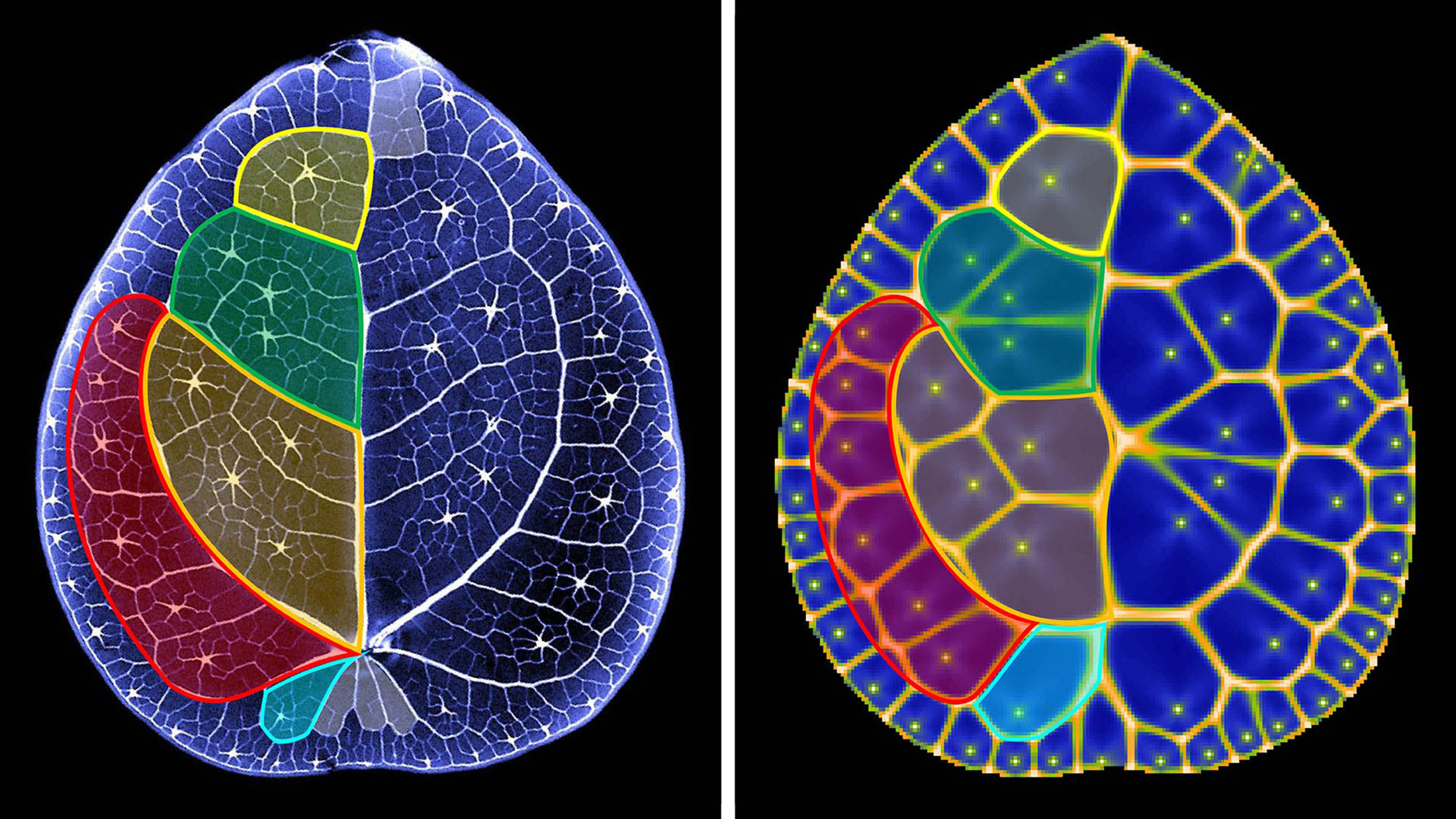
By mapping veins and pores on dozens of money plant leaves, they showed the network forms a Voronoi diagram – a geometric pattern that divides space into regions, with each one surrounding a single central point – around tiny pores called hydathodes.
The lead authors are Cici Zheng, a former CSHL graduate student now at the Allen Institute, and Saket Navlakha, an associate professor at CSHL who studies how organisms use algorithms to solve problems.
Their collaborator was Przemysław Prusinkiewicz of the University of Calgary, who has spent decades studying how plant veins form.
The team analyzed 34 leaves from six plants. About 73 percent of the looped polygons formed by major veins contained exactly one pore. The geometry was too clean to be a coincidence.
Voronoi diagram in the leaves
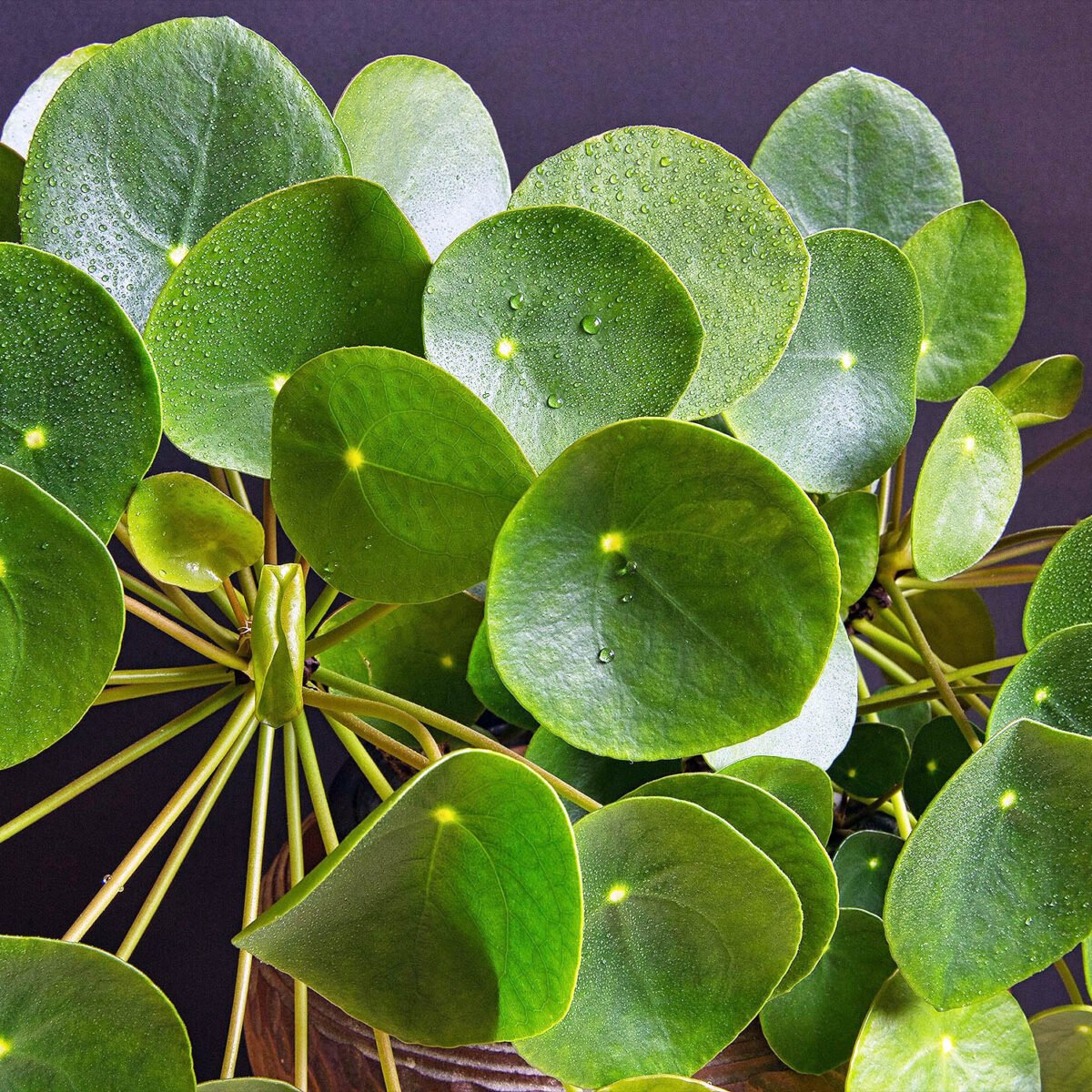
Pilea peperomioides leaves look almost circular. Looping veins weave across the surface in closed loops, carrying water and nutrients to every part of the leaf.
Scattered across each leaf are hydathodes – tiny pores that release excess water, manage the leaf’s fluid balance, and even help defend against bacterial invaders.
A Voronoi diagram divides space by closeness. Drop centers onto a flat surface, and the diagram carves it into regions, with one center per region – and every spot inside a region closer to its own center than to any other.
City planners use it to draw school districts. Voronoi-like patterns turn up across nature, from giraffe spots to dragonfly wings, but until now, none had both visible centers and visible edges that matched the math.
The money plant has both. Each pore sits near the center of its polygon, with major veins forming the dividing lines between them.
Near-perfect plant geometry
Zheng and Navlakha ran three tests. One compared angles and distances between adjacent polygons. Another checked whether actual veins matched the lines a Voronoi diagram would draw between pores.
The third test worked backward, predicting pore locations from the vein polygons alone. Pores landed significantly closer to the predicted Voronoi centers than to any other reference point the researchers tested.
Vein angles were off by only about 8 degrees on average. Region overlap reached 72 percent. On a living surface that grew without instructions, that is near-textbook geometry.
Pattern stays under stress
To check whether the pattern was hard-coded or flexible, the team grew plants under shade, intense light, and high heat.
Leaves came out smaller, larger, paler, and more crinkled. Hydathodes changed in size. The Voronoi structure stayed intact.
That preservation rules out a fixed genetic blueprint. Local cells, local rules – whatever the plant is doing happens in real time as the leaf grows.
Plants solve geometry differently
Plants do not have brains. They cannot pull out a ruler and measure the distance to the nearest pore. So how does a leaf produce geometry this clean?
“Unlike humans, plants cannot explicitly measure distances! Instead, they rely on local biological interactions to achieve the same Voronoi solution,” Zheng said.
It is not a blueprint. Just cells reading local signals and acting on them.
Hormones shape leaf veins
The team thinks the answer involves auxin – a hormone the plant uses to direct growth. For decades, vein formation was explained through a process called canalization, the subject of a recent review.
In that older model, auxin flows from one part of the leaf to another and carves out narrow channels that become veins. But canalization mostly produces branching trees, not the closed loops the money plant shows.
The new model treats each hydathode as an auxin source. From each pore, the hormone spreads outward in a wave. When waves from neighboring pores collide, they form a ridge exactly halfway between them. That ridge is where the vein appears.
Computer simulations matched real leaves closely. Lab tests were consistent with the model too – staining showed auxin carrier proteins clustering around money plant pores much as the wave model predicts.
Voronoi diagram and money plants
Until now, no one had documented a true Voronoi diagram occurring in nature with both visible centers and functional edges. The money plant is the first.
That changes what biologists can ask. Looped veins occur in nearly every flowering plant. If wave-collision works in the money plant, the same logic may apply across many species. It does not overturn earlier research on canalization. Instead, it adds to it.
“For decades, the question of how reticulate veins form has remained open, and finally we have a plausible answer,” Prusinkiewicz said. The team plans to test the model in other species next.
To most people, a money plant is just a cheerful houseplant sitting on a windowsill. The math happens anyway. Quietly, in every leaf, every day.
The study is published in the journal Nature Communications.
—–
Like what you read? Subscribe to our newsletter for engaging articles, exclusive content, and the latest updates.
Check us out on EarthSnap, a free app brought to you by Eric Ralls and Earth.com.
—–
[ad_2]
Source link