Investing in AI leader Anthropic shows how Scottish Mortgage builds conviction about what we can’t yet know, manager Tom Slater writes.
As with any investment, your capital is at risk.
A favourite saying at Anthropic is that generative AI models are ‘grown more than built’.
Its researchers liken the process to gardening. You can pick the species of flower, plant it in a spot with optimal sunlight and water and erect a supportive trellis. Yet you can’t predict the exact form it will take – what leaves will sprout where or the delicate geometry of the bloom.
Similarly, despite their engineering skills, Anthropic’s staff have been repeatedly surprised by some of the emergent capabilities of their Claude-branded large language models (LLMs – systems trained on vast amounts of text).
For example, they assumed its chatbots wrote poetry sequentially, word by word. In fact, they discovered, the models planned ahead, first picking a potential rhyming word to end a line and only then writing text to lead up to it.
Or, to give a less whimsical example, Anthropic has revealed its latest LLMs can detect when they are being tested and sometimes adjust their output accordingly. This adds to the challenge of checking they are safe and ready for release.

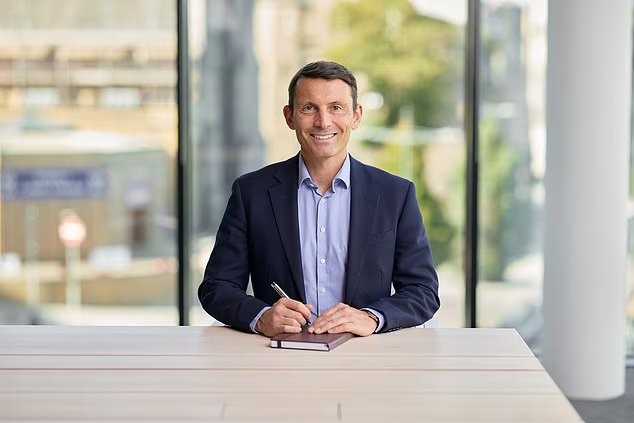
Scottish Mortgage manager Tom Slater: With AI, it’s difficult to stay at the cutting edge but Anthropic’s Claude large language models are leading the way
Being comfortable with the unpredictable
The unpredictability of the technology is just one of many uncertainties inherent to the privately owned company.
When Scottish Mortgage took a stake in August 2025, we knew we were backing a business that neither fully understood what it had created, nor could confidently forecast demand, even a year out.
But Scottish Mortgage’s job isn’t to predict the future perfectly. If fund managers did that, stock prices would reflect all future information. Instead, we maximise the chances of making good decisions by recognising uncertainty, accepting that the range of potential outcomes widens the further out we peer – and then look for factors that let us build conviction.
In the case of AI, LLMs produce better responses with more computing power, data and sophisticated algorithms. We can’t be sure how long that will persist, but it’s an established trend.
We know that industry and society at large currently use these systems narrowly. But there are all sorts of other possibilities, even in the unlikely scenario that the models don’t continue improving.
And we are seeing sales explode. In Anthropic’s case, its annual run-rate revenue – a 12-month performance estimate based on extrapolating a shorter period’s sales –increased from about $10m in 2022, to $100m in 2023, to $1bn in 2024, to $14bn at the time of writing. That exceptional growth tells you it’s fulfilling an unmet need.
Can that exponential rate continue? We expect it to slow, but there is every sign that growth will remain rapid.

The ability of Anthropic’s Claude AI models has increased substantially but it has not always followed the path that was expected
Why Anthropic has an edge
Another key factor is asking what gives a company its edge. For a time, these LLM creators struggled to differentiate their products – even when a model was best-in-class, it was almost certain to be superseded within months.
More recently, it’s become clear that it’s difficult to stay at the cutting edge. Only a handful – Anthropic, OpenAI, Google and xAI – have demonstrated that ability consistently.
In Anthropic’s case, a focus on business customers differentiates the firm from its peers. That has helped it prioritise specialisms such as coding over more consumer-centric features, such as image generation.
There are approximately 21 million software developers on company payrolls worldwide with a labour cost approaching $900bn. And IT departments using Claude Code – or third-party coding tools that Anthropic’s models power – typically report productivity gains of 20 to 30 per cent.
It is a huge market, even before you consider that this technology also enables non-coders to write software and generates ‘disposable code’ for one-off tasks. If a chatbot has drawn you a graph or calculated a complex sum, it probably wrote some instant code to do so.
Anthropic’s ambitions aren’t limited to the corporate world, however. The UK government will trial a Claude-powered AI assistant to support jobseekers using its GOV.UK website.

Anthropic founder Dario Amodei says it must prioritise safety
Why Anthropic founder Dario Amodei stands out
Scottish Mortgage places enormous importance on the role of founders. Anthropic has seven, all of whom are still actively involved. I’ll highlight one: chief executive Dario Amodei, who led the development of OpenAI’s GPT-2 and GPT-3 models before founding a company of his own.
In my conversations with Dario, I’ve been struck by his principled view that Anthropic must prioritise safety, whether in terms of discrimination, bias, child protection or mental health.
This diligence may mean a conservative approach to product development. But it’s helped the firm avoid the pitfall of generating harmful and inflammatory material.
Business customers need to minimise such risks. Their perception that Anthropic is the most cautious in this respect can only accelerate Claude’s adoption.
Dario has also talked about how his father’s death helped set him on his path: Riccardo Amodei died in 2006 after a long illness. A few years later, a treatment with a 95 per cent cure rate became available.
The experience convinced Dario to switch his university studies at Princeton from theoretical physics to biology and computational neuroscience, which in turn led him to AI.
We’ve seen from our other portfolio companies that founders with a combination of extraordinary intelligence, singular focus and a motivating trauma in their past often have incredible drive. Dario talks about having a sense of urgency to improve billions of lives with AI by means of augmenting medical research, education and economic development.
From chatbots to intelligence on an industrial scale
That ambition carries through into Anthropic’s culture. The company has the highest employee retention among the major AI labs, despite rivals offering top talent many tens or even hundreds of millions of dollars to switch. That suggests Anthropic doesn’t have a mercenary workforce.
Businesses seldom escape from their founding culture. Doing so would effectively require thousands of employees to turn up one day and say: we’re not going to do it like that any more.
My observation is that’s a vanishingly rare thing to happen. So, when you find a culture like this, it signals dedication and durability.
The venture capitalist Michael Moritz once told Foreign Affairs that one of the most consistent investment problems is that ‘collectively, we have a wonderful ability to underestimate the potential of a company that becomes great’.
Does that come from failure of imagination or too much cynicism? I don’t know. But we aim to counterbalance such instincts with the knowledge that it’s often uncertainty that creates opportunity.
Investing amid uncertainty is nothing new for Scottish Mortgage. When we took a stake in NVIDIA in 2016, AI was one of several possible growth drivers, and it was far from certain which, if any, would materialise. But we judged the company had unique qualities, a founder with a high tolerance of risk and enormous upside potential.
Today, Anthropic sits alongside reusable-rocket pioneer SpaceX and drone-delivery specialist Zipline in our portfolio. These companies have growing revenues and a proven market fit, but their industries are still nascent and there is plenty else to be uncertain about.
However, of one thing I am sure. We live in a world constrained by access to intelligence. Think of a doctor struggling to diagnose a rare disease, an executive benchmarking the competition or a teacher personalising a lesson plan to 30 individual pupils.
If a company can supply intelligence on an industrial scale, boost global productivity and capture some of the value it creates, then it ought to be able to grow bigger by an order of magnitude.
This article originally featured in Baillie Gifford’s Spring 2026 Trust magazine.
Important information
This article does not constitute, and is not subject to the protections afforded to, independent research. Baillie Gifford and its staff may have dealt in the investments concerned.
Scottish Mortgage has a significant investment in private companies. The Trust’s risk could be increased as these assets may be more difficult to sell, so changes in their price may be greater.
Some of the views expressed are not necessarily those of Baillie Gifford. Investment markets and conditions can change rapidly, therefore the views expressed should not be taken as statements of fact nor should reliance be placed on them when making investment decisions.
Baillie Gifford & Co and Baillie Gifford & Co Limited are authorised and regulated by the Financial Conduct Authority (FCA). The investment trusts managed by Baillie Gifford & Co Limited are listed on the London Stock Exchange and are not authorised or regulated by the FCA.
A Key Information Document is available by visiting bailliegifford.com