

[ad_1]
We often hear the phrase, “Money is the root of all evil.” Let’s look at it from a different perspective.
Money, in and of itself, is neither holy nor corrupt. It is a tool.
And when viewed properly, money may be understood as one of the most practical and powerful forms of chesed—loving-kindness—that G-d has placed in the world.
A New Way to Look at Money
Recently, while studying Love Your Neighbor as Yourself by Rabbi Zelig Pliskin, I was reflecting on the mitzvah of loving one’s fellow human being and how that ideal expresses itself in daily life.
As I left the kollel (an institute for advanced full-time or part-time Torah study) one day, I looked across the street at a supermarket.
Suddenly, I saw the building in a completely different way.
Someone’s capital financed the construction of that store.
The store provides food and essential products to thousands of people.
It employs cashiers, stock clerks, managers, and delivery workers.
Those employees earn salaries that support their families.
Families use those wages to buy food, clothing, education, and housing.
In one simple supermarket, I saw a vast network of kindness.
And at the center of it all was money.
Money as Mobile Chesed
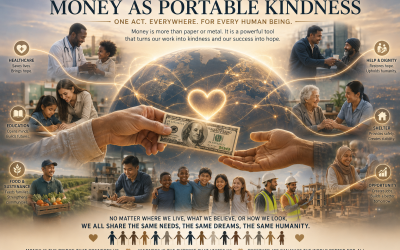
Money is, in essence, portable kindness.
It allows one person to transfer the fruits of their labor to another person in a highly efficient way.
Before money, people relied primarily on barter.
Barter was cumbersome and limited. If I had grain and needed shoes, I first had to find a shoemaker who wanted grain.
Money changed that.
It became a universal medium through which human beings could exchange value and serve one another on a massive scale.
In this sense, money is chesed in motion.
It is kindness made tangible.
It is the means by which one person’s productivity becomes another person’s blessing.
Yaakov Avinu and the Birth of Coinage
The Midrash teaches that Jacob instituted coinage when he arrived in the city of Shechem.
The verse states:
“And he arrived safely at the city of Shechem.”
(Genesis 33:18)
Our Sages explain that Jacob contributed to the city by establishing three institutions: coinage, marketplaces, and bathhouses.
This teaching reveals something profound.
Coinage is not merely an economic innovation.
It is a civilizational act of kindness.
By creating a reliable medium of exchange, Jacob enabled commerce, cooperation, and prosperity.
He gave society a practical mechanism for expanding chesed.
Wealth as Responsibility
When a person earns money honestly, they are creating stored potential for good.
With money, one can:
- Feed a hungry family.
- Provide shelter and clothing
- Support Torah learning.
- Build schools and synagogues.
- Invest in businesses that create jobs.
- Care for the sick.
- Strengthen communities.
- Preserve and enhance life,
Money can certainly be misused.
But the same is true of any powerful instrument.
A knife can heal in the hands of a surgeon or injure in the hands of a criminal.
The moral value lies not in the tool, but in the hand that wields it.
Chesed (Kindness) on Steroids
Standing outside that supermarket, I realized that money is more than paper, coins, or digital numbers on a screen.
Money is kindness multiplied.
It enables us to help not just one person, but hundreds, thousands, or even millions.
It turns good intentions into practical reality.
It transforms vision into sustenance.
It converts compassion into infrastructure.
Money is, in many ways, chesed on steroids.
A Torah View of Prosperity
The Torah does not glorify poverty.
It glorifies righteousness.
And when wealth is acquired ethically and used wisely, it becomes a vessel for Divine blessing.
King Solomon teaches in Proverbs:
“The blessing of the Lord, it makes rich, and He adds no sorrow with it.”
(Proverbs 10:22)
The ideal is not wealth for ego.
It is wealth for service.
Not money as an idol, but money as an instrument of holiness.
Final Thought
The next time you look at a store, a business, a paycheck, or an investment, consider a different perspective.
Money may be one of G-d’s greatest gifts to humanity.
It allows us to transform our labor into love, our success into service, and our resources into redemption.
Money is not merely currency.
It is tangible chesed—kindness.
And in the hands of good people, it becomes a force capable of changing the world.
Rabbi Avi Schwartz is an individual who has made contributions in various fields. He is the son of Motke Eish HaGarzen, also known as Motke the Axeman, a legendary figure in the Palmach. Motke Eish HaGarzen led a group of 21 Palmach Warriors who successfully conquered Har Tzion (Mount Zion), rescuing 1,700 Jewish men, women, and children from the Jordanian onslaught in the Jewish Quarter of the Old City.
Rabbi Schwartz himself is a Black Hat Rabbi and activist, dedicated to upholding Jewish traditions and values. Alongside his religious pursuits, he has also found success as a filmmaker and writer, with his works featured on platforms such as Red Coral Universe Apple TV, Tubi of Fox Corporation, and Netflix.
Notably, Rabbi Schwartz’s movie “The Quest” has received high praise from none other than Pat Boone, a Music and Hollywood Icon. Boone, known for his illustrious career as a singer, actor, and television personality, has publicly commended Rabbi Schwartz’s film, acknowledging its quality and significance. This endorsement from Pat Boone further solidifies the impact and recognition of Rabbi Schwartz’s work within the entertainment industry.
Beyond his artistic endeavors, Rabbi Schwartz has been at the forefront of the battle against the Boycott, Divestment, and Sanctions (BDS) movement. He has developed two groundbreaking apps, “Fight BDS” and “BDS Myth Busters,” aimed at countering BDS propaganda and raising awareness about the realities of the movement. The notable Hollywood icon and anti-BDS activist, Roseanne Barr, sponsors the app “BDS Myth Busters.”
Additionally, Rabbi Schwartz holds the position of Vice President of Digital Marketing and serves as the Director of Energycite, a revolutionary technology in energy conservation. His involvement in this field highlights his commitment to sustainability and environmental responsibility.
Furthermore, Rabbi Schwartz has established the Torah Teen Palmach Center, a transformative initiative that trains teenagers to become future leaders in the spirit of the Palmach. Through this center, he imparts invaluable leadership skills and instills the values of courage, determination, and resilience in the next generation.
[ad_2]
Source link