

[ad_1]
Macau Business magazine l May 2026
By Jorge Godinho

Macau casino gaming has changed considerably with the major reforms enacted since 2022, which included ending the subcontracting practices for “satellite” casinos and VIP rooms, and ending the junket system based on revenue sharing. These changes should have greatly diminished money laundering opportunities in Macau casinos. However, there has been a post-pandemic sharp rise in the number of suspicious transaction reports (STRs), which now stand at or near an all-time high. What is going on? Should we be worried?
According to the Macau financial intelligence unit (known as GIF), in 2025 there were 3603 STRs from the gaming industry, a small decline from 2024 (3837). In 2023 there were 3431 reports. The first quarter of 2026 saw 997 reports — on track to double the pre-pandemic numbers of 2019 (1913 reports) and 2018 (2087 reports).
The question that arises is obvious: why have suspicious reports nearly doubled between 2018/19 and 2024/25? The answer is not simple, as two aspects make the recent numbers hard to understand.
First, the size of the gaming industry certainly has not doubled. Far from it. The 2025 GGR is still below that of 2019. Therefore, the STR-to-GGR ratio is very different now. Macau is operating at structurally higher AML reporting intensity than in the pre-Covid system. In 2019 the junket system was still in place, with higher risk, but there was a lower STR density. And the number of casinos has gone down considerably with the closure of the “satellites”: from 41 in 2019 to 20 in 2025. So why is an industry with less casinos and less revenue now generating a lot more STRs?
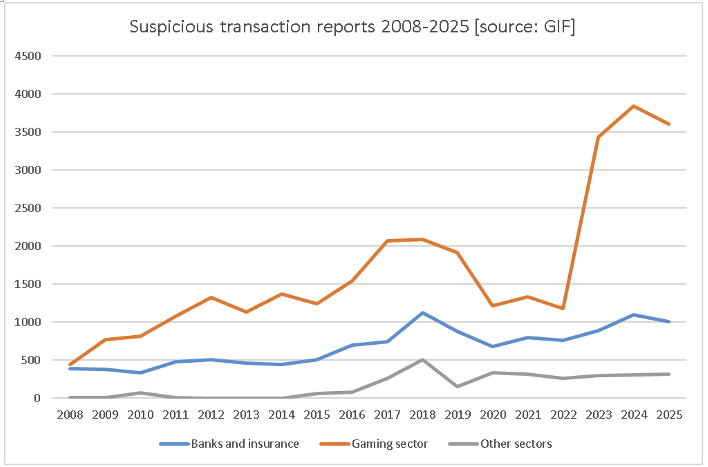
Second, the number of cases sent from GIF to public prosecutors has remained relatively stable. In other words, referrals for prosecutions have not dramatically increased. The number of cases sent for prosecution was 121 in 2018, 171 in 2019, and then 142 in 2024. It appears that, after looking into the reports, GIF does not see many more laundering cases worth prosecuting as before, and a lot more reports seem to be false positives. A much-enlarged size of reports is not generating many more prosecutions.
So, what exactly is going on?
As an academic who has no information that is only available to those on the public and private “frontlines” (government and concessionaires), I have no data to probe what may be happening. Seeing this from the outside, I would be inclined to research two types of explanations: changes in laundering behavior and possible overreporting.
As well known, the current context is marked by the prominence of the mass market, which overtook the VIP sector in 2020, and is now much larger. There could theoretically be a lot more transactions with smaller amounts, in a return to what is known in anti-money laundering circles as “smurfing”. This expression describes breaking up a large amount of illicit money into many small transactions so that each individual transaction stays below reporting thresholds and appears ordinary. “Smurfing” is usually done by an army of launderers all doing more granular and frequent mass/premium-mass smaller transactions, to keep under the radar. With more touchpoints there will be more STR triggers and more interconnected cases. The Taiwan laundering case recently reported in the press seems to fit this pattern.
In the post-junket compliance environment, operators face heightened scrutiny. There may be an incentive to overcomply rather than underreport
The total number of STRs says nothing about laundering volumes, which are not disclosed by GIF. But we know that, according to the official data on typologies (GIF annual reports), “chip conversion without real gambling” leads with 1596 reports in 2024 (the 2025 report should be available around August 2026). This typology refers to a classic casino-based money laundering method that may indicate “smurfing”. This could be a partial explanation.
The other conceivable explanation is overreporting, which is a classic problem in AML detection, especially when compliance relies heavily on automated monitoring. Modern AI-driven compliance systems can inflate STR volumes: they are typically calibrated to minimize false negatives (not missing suspicious activity), which mechanically leads to higher false positives and a more conservative reporting behavior. In practice, compliance teams may be adopting a stricter “report if in doubt” posture to avoid regulatory problems.
In the post-junket compliance environment, operators face heightened scrutiny. There may be an incentive to overcomply rather than underreport. There may be an overreporting bias. The use of software to help compliance is not new, but modern AI-driven compliance may inflate STR volumes through conservative detection thresholds and false positives.
Or maybe the explanation lies in the intersection of the various aspects indicated: there is a lot more “smurfing” now, and it is getting caught and reported much more frequently, but does not create a lot more prosecutions because reports of “smurfing” are by nature interconnected and part of a larger single laundering scheme.
This analysis is somewhat speculative, and the only sure thing is that the STR numbers are now much higher. An increased quantity of a large magnitude indicates a qualitative change. It seems that everything is working better now. However, as I said, an independent academic has no sufficient information available to reach conclusive explanations for what clearly is a significant evolution in the operation of the Macau anti-AML systems. Maybe the G2E Asia conference in May can provide answers or perhaps the academic community may try to study this field in more detail.
[ad_2]
Source link