
Good morning. Just when we thought the AI financing boom had peaked, word came that Alphabet is planning to sell a 100-year bond. Investors have been happy to fund tech companies’ AI ambitions so far, but we wonder if there is a limit to the appetite for long duration finance as the sums invested in data centres shoot higher. Send us your thoughts: unhedged@ft.com.
Memory stocks
Here’s a chart:

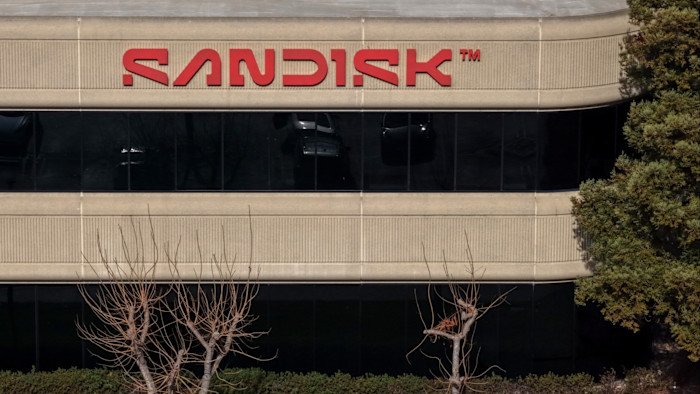
These are all companies that make computer memory. Western Digital and Seagate make hard disc drives (slow, low-cost storage). Micron, SK Hynix and Samsung focus on Dram (fast, expensive memory for use in active applications) and SanDisk specialises in Nand (middle-priced, solid-state memory for quick retrieval). It is easy to be hypnotised by the staggering 1,200 per cent rise in SanDisk’s shares in the past six months. But the others are all up 180 to 280 per cent over the same period. SanDisk, Western and Micron are the three best performing stocks in the S&P 500 over the past year.
It’s been a blistering run, driven by the AI boom’s apparently bottomless thirst for memory. Memory prices have been a tear (see here). SanDisk has been the star recently because it has only just become clear how much Nand AI applications will require. The company has gone from burning cash in 2024 to generating almost a billion dollars in free cash flow in the past quarter alone.
The memory industry is intensely cyclical. Demand rises and falls quickly and supply is slow to respond, leading to shortages, gluts and wild price swings. Between mid-2020 and January of 2022, shares in Western, Seagate, Micron and SK Hynix all rose 100 per cent or more, only to give it all back in next nine months:

There were cycles of equal or even greater violence that peaked in 2014 and 2018. But the sheer speed of the most recent run in the share prices throws previous interactions into the shade. So: will the decline be as violent as rise? When will it come? Or is this cycle different?
“It’s incredible what’s going on with the memory stocks. Investors have such short memories,” one industry insider told me. They described how the 2022 cycle was a product of memory vendors competing for contracts from suppliers to the big cloud computing “hyperscalers”. The suppliers — server makers and the like — order memory to meet hyperscaler demand even before they have won a contract, because to win a deal they have to demonstrate they have supply on hand. But not every supplier gets a contract, there are orders in excess of actual demand. Meanwhile, the hyperscalers overestimate their own needs, and when they cut their orders, the oversupply becomes a glut. “Double/triple orders are already happening and capacity is being added,” the insider says (Samsung recently announced a big increase in Dram capacity).
Still, everyone expects this expansionary stage of this cycle to be longer than usual — potentially another several years — because demand is so extraordinary. “You look at history, you look back five years, it’s going to correct,” says Jonathan Goldberg of Digits to Dollars Advisory. “The amplitude of this cycle is greater, so it can go up from here. [But] there are a lot of [investors] in semiconductors who weren’t around five years ago, who will say this time is different. But the fact is the cycle has not changed.”
Others argue that the emergence of High Bandwidth Memory means that things will be different this time. HBM is a specialised form of Dram for high-performance computing made by Samsung, SK Hynix and Micron. “So much of this cycle is being driven by HBM,” says Ben Bajarin of Creative Strategies. “There is more differentiation; it does not become a commodity any time soon . . . I think there is a new floor for memory revenues.”
If any seasoned memory investors have thoughts on how best to time the top of this cycle — however long or short it may turn out to be — please do email us.
(Armstrong)
Takaichi
The Takaichi era has begun. Japanese Prime Minister Sanae Takaichi was already popular with the general public leading into Sunday’s snap general election, but her party’s supermajority in the polls opens the way for more aggressive policy, particularly on the fiscal front.
Japanese stocks cheered the result, continuing their upward trend since October and hitting a new record:

Meanwhile, the dollar/yen exchange rate was relatively stable. Long-dated Japanese government bonds, which have been nervous about Takaichi’s calls for tax cuts and fiscal stimulus, sold off but much more gently than in January when Takaichi pledged to suspend the 8 per cent sales tax on food:

The election victory was the easy part. The big gamble is whether she can successfully execute on fiscal expansion. Marcel Thieliant of Capital Economics believes that Takaichi’s fiscal talk may be more bark than bite, explaining why the 10-year JGB didn’t sell off as heavily as in January:
That episode seems to have prompted some soul-searching even amongst the most reflationist members of the government’s Council on Economic and Fiscal Policy. Accordingly, we view the recent fiscal expansion as an attempt to bolster public support ahead of the election rather than as a sign of things to come.
If, however, Takaichi does take advantage of her supermajority and follow through, the markets will face a reckoning. Japan’s gross public debt is staggering; and in a fully fledged debt crisis, the safety net of financial assets, including foreign exchange reserves, Treasuries, JGBs and equities are limited.
Karen Fishman of Goldman Sachs believes that the muted initial market response will eventually give way to increased volatility as fiscal risks materialise:
We do not see the fiscal implications as fully priced . . . We had said that it is difficult to conjure a scenario where fiscal premium can be eliminated in the short run, and this result is instead likely to add to it. We maintain that the most durable path to a stronger yen is through smaller fiscal ambitions, weaker inflation outturns, or rising global recession risks. Recent developments have pushed in the opposite direction.
(Kim)
One good read
FT Unhedged podcast

Can’t get enough of Unhedged? Listen to our new podcast, for a 15-minute dive into the latest markets news and financial headlines, twice a week. Catch up on past editions of the newsletter here.