
[ad_1]
Should restaurant investors pay closer attention to labor issues at Starbucks SBUX and other operators? Five of Starbucks’ stores in Ontario, Canada, recently ratified collective bargaining agreements, representing a major milestone for the 11,000 workers represented. In the US, meanwhile, unionization efforts could continue into 2026 if momentum picks up again after high-profile politicians joined the strikers’ picket line in December.
To answer that question, consider that labor typically accounts for over 30% of restaurants’ operating costs, which means that changes in wages, staffing flexibility, or store operations can materially affect margins and profitability. Some restaurant chains and shareholders view unions as a cost burden. Separately, empirical research indicates that union-initiated lawsuits or disputes can lead to temporary store closures, staffing shortages, or operational inefficiencies. Nevertheless, while collective bargaining can increase short-term costs, it may also reduce long-term volatility.
Starbucks is one example of how worker-relations issues within the restaurant sector can create financially material environmental, social and governance risks. Investors may consider integrating them into risk assessments, engagement strategies, and valuation models using Morningstar Sustainalytics Controversies and ESG research. For investors monitoring labor controversies, this information, alongside Morningstar Equity Research, can be used to evaluate restaurant stocks such as Chipotle Mexican Grill and Domino’s Pizza Group.
Financial Risks Related to Labor Disputes
Freedom of association and collective bargaining are fundamental human rights under international law. Article 20 of the United Nations’ Universal Declaration of Human Rights and ILO Conventions 87 and 98 affirm workers’ rights to organize, negotiate workplace conditions, and take collective action, including striking. Collective bargaining agreements covering wages, safety, and dispute resolution can reduce government intervention and foster trust between employers and employees. Respecting these rights can enhance economic performance, yet violations remain widespread. Some 80% of countries restrict collective bargaining; 88% of countries violate the right to strike, the US Department of Labor has found that empowering employees and unions is the most effective means of ensuring labor rights.
Labor rights violations represent financial risk, not just ethical concerns. Companies are exposed to reputational risk, mainly driven by negative media reporting during labor disputes. From an investor perspective, violations can lead to higher turnover, wage pressures, and operational inefficiencies. Reputational risk and legal liabilities can also directly affect brand value, influencing investor confidence.
How We Capture Labor Risks for Restaurant Stocks
Morningstar Sustainalytics monitors these labor disputes through its Controversies research, which feeds into ESG Risk Ratings by increasing the risk exposure score and diluting the management (of risk) score when significant labor-related risks are present. Aside from a risk score, controversy events are also assigned an impact score. This allows investors to quantify and track labor risk, as well as stakeholder impact across companies and subindustries. ESG Risk Ratings assess management of labor relations via two key indicators: (1) Freedom of Association Policy, which evaluates an explicit commitment to uphold rights with reference to ILO conventions, and (2) Collective Bargaining Agreements, an indicator that measures the percentage of employees covered, signaling the company’s structural exposure to labor disputes and operational risk. Both indicators feed into the Human Capital material ESG issue.
Most restaurants in our coverage have strong freedom of association policies, yet collective bargaining adoption remains low, highlighting a structural vulnerability. Many employees lack union representation. That can lead to higher turnover, wage pressures, and disputes that disrupt operations. For investors, this translates into financial exposure that may not be considered in traditional risk assessments and valuation.
What Labor Disputes Mean for Restaurant Investors
Exhibit 1 shows that labor-related controversies are disproportionately concentrated within the restaurants sector. Companies with higher unionization rates tend to have lower employee turnover, demonstrating a potential financial benefit for the company. Conversely, labor disputes can reduce consumer trust, create operational disruption, and affect revenue growth. Despite strong policies, McDonald’s and Starbucks are involved in controversies with significant impact, indicating that policy alone does not secure workers’ rights.
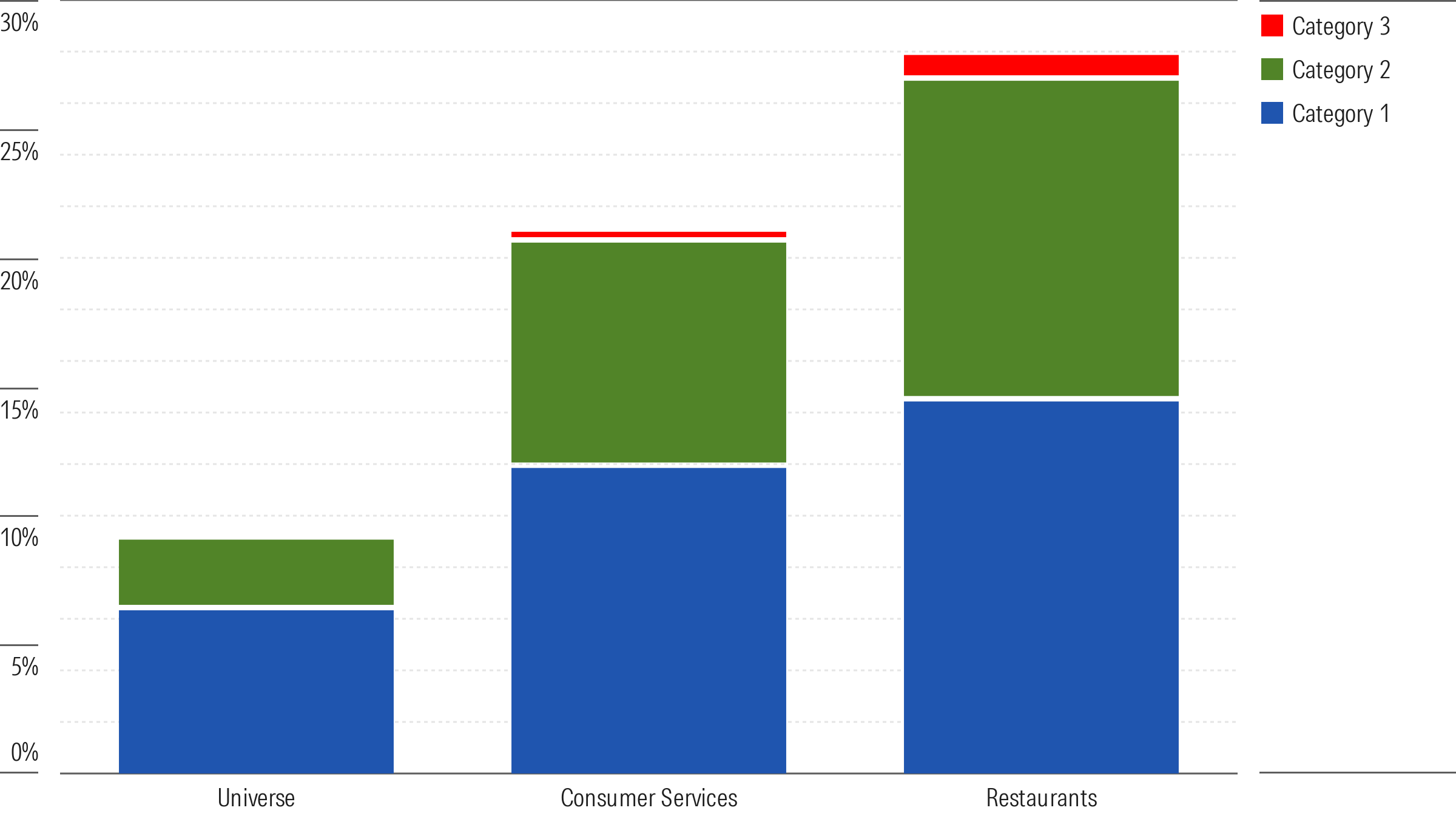
For Starbucks, scrutiny over union-busting allegations demonstrates the challenge of aligning policy with practice. While we rate the company as a Category 2 (Moderate) in terms of its Event Risk Score, the company has a Category 3 (Significant) rating regarding its Event Impact Score. Controversies with significant impact can morph into reputational and operational risk through stakeholder action and media exposure. Investors can take care not to underestimate reputational and operational risks triggered through strikes, elevated turnover, and employee dissatisfaction. Reputational risk is particularly material for consumer-facing companies as customer trust drives revenue. In Starbucks’ case, ongoing labor disputes have coincided with media attention, political debate, and stakeholder actions, including universities cutting ties and investor-led calls for accountability. These developments could influence customer sentiment, same-store sales, and broader financial performance. Over 100 US government officials urged Starbucks to continue bargaining in December 2025, and investors have repeatedly asked Starbucks to bargain in good faith.
Top Stock Pick: Chipotle Mexican Grill
We can combine insights from the ESG Risk Rating with Morningstar’s Equity Research to evaluate which restaurant stocks offer an attractive profile for investors, explicitly incorporating labor considerations. Interestingly, most restaurants trade close to their fair value, receiving 3 stars, while one stock pick in our group is undervalued.
Based on our research combining Morningstar Sustainalytics’ ESG Risk Rating and Morningstar Equity Research, Chipotle stands out as a top choice among restaurants. In terms of ESG risk, Chipotle shows strong management, and we consider its Human Capital risk to be Negligible (1.8). Nevertheless, Chipotle is involved in a moderate controversy related to labor relations: In 2022, the company was subject to several allegations of union busting after its first store unionized, with bargaining efforts still ongoing. The following year, the company was ordered to pay former workers $240,000 after closing a store where employees sought to unionize. There were no similar allegations in 2025, though investors would be wise to monitor related developments. The company receives a Morningstar rating of 4 stars, and Morningstar Equity Research considers it undervalued. Chipotle benefits from a wide economic moat, driven by brand strength, pricing power, and a differentiated fast-casual positioning. From an ESG perspective, meaningful positives justify ongoing investor interest.
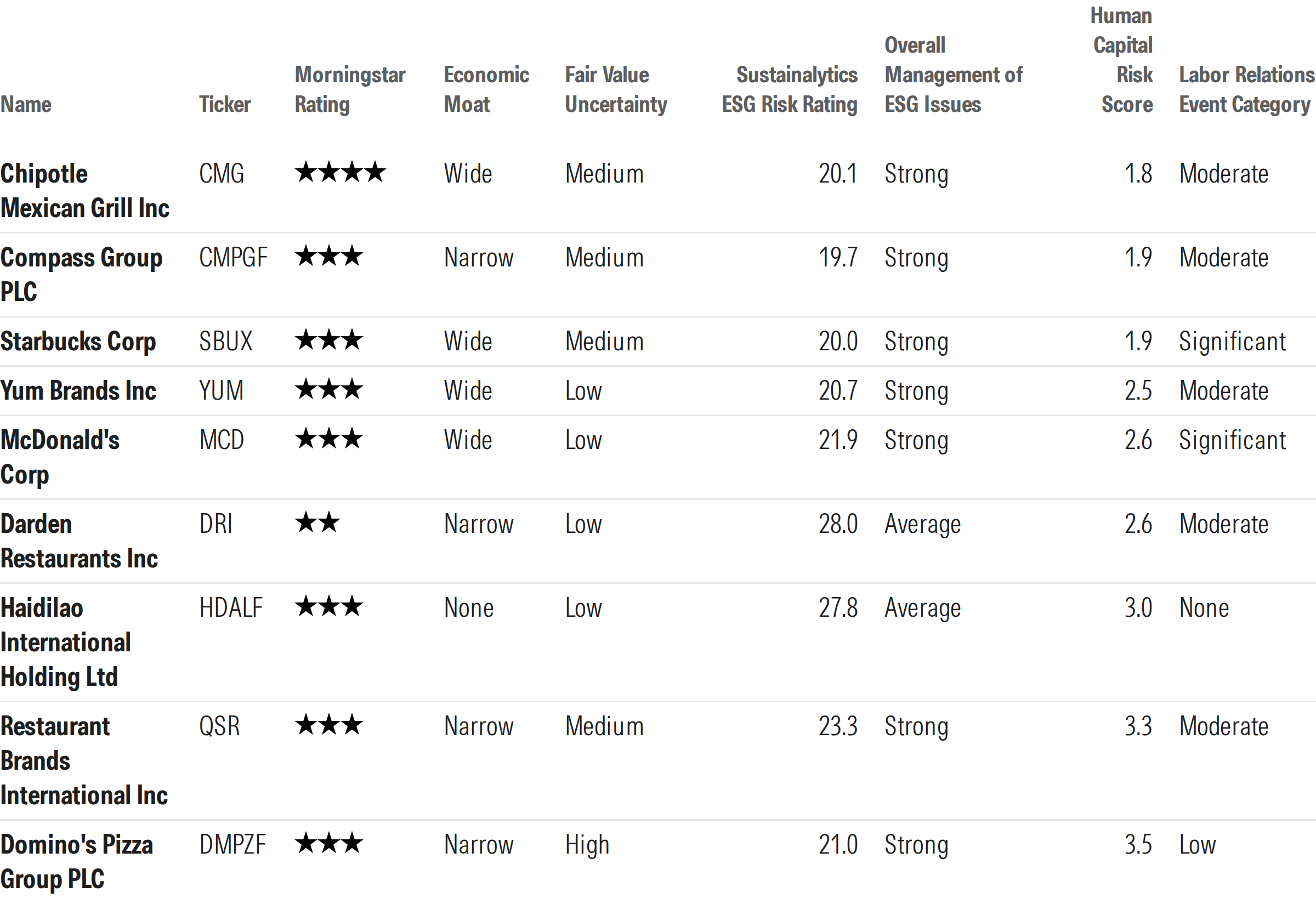
The table also shows data for Compass Group, Yum Brands, Darden Restaurants, Haidilao International, and Restaurant Brands International.
Domino’s is the only name in the peer group to exhibit low risk both in terms of labor relations events and labor impact. However, while the company has overall strong management of ESG risks, it exhibits the highest risk among the companies examined in terms of human capital issues. Domino’s exposure to this type of risk is higher than a typical restaurant because 97% of its stores are franchised, resulting in a lower level of operational control. The company has released a policy on freedom of association but lacks important management initiatives, including meaningful initiatives for talent recruitment and development. Moreover, Domino’s carries a narrow economic moat and high fair value uncertainty.
Starbucks and McDonald’s merit separate consideration. Both companies benefit from wide economic moats, reflecting powerful brands, global scale, and durable consumer demand that underpin long-term value creation. However, they are also the only companies in the group flagged for significant labor relations impact events, reflecting their scale as employers and heightened exposure to unionization activity, wage pressure, and labor-related controversies. These factors can create financial risks through higher operating costs, operational disruption, or reputational damage. Investors can apply these insights across consumer-facing restaurants by monitoring labor policies, collective bargaining coverage, unionization trends, and involvement in labor-related controversies as part of fundamental risk assessment and valuation analysis.
[ad_2]
Source link