
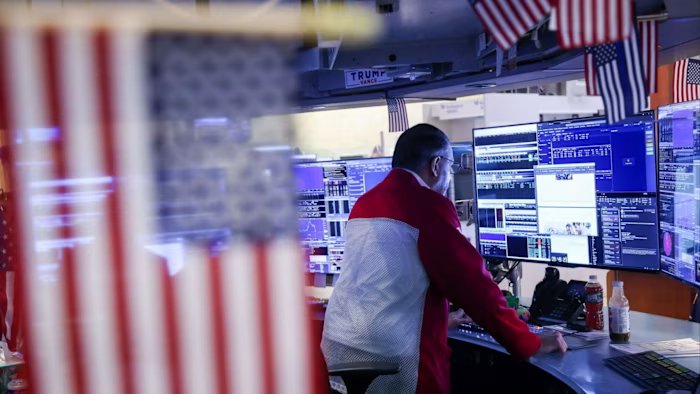
Investors are betting the Trump administration will run the economy “hot” ahead of midterm elections, with buoyant stocks and a weaker dollar reflecting expectations of strong growth and rising inflation.
A string of robust economic data has defied predictions of a slowdown in the US, sending credit spreads to the tightest levels of the century and helping stocks hit fresh record highs this month.
At the same time, fund managers said there is a growing belief that President Donald Trump’s tax cuts, deregulation push and campaign for lower interest rates will add more fuel to the economy this year, as the president seeks to bolster support ahead of November’s congressional polls.
“There is a carefully engineered plan to have the US economy humming into the summer,” said Arif Husain, head of global fixed income at T Rowe Price.
Trump boasted last week in Davos of “exploding” US growth, after figures showing GDP expanded at an annualised rate of 4.4 per cent in the third quarter of 2025, powered in part by the AI boom. The Atlanta Federal Reserve’s GDPNow model is forecasting an acceleration to 5.4 per cent in the final quarter of last year.

Despite the economy’s rude health, investors expect the Federal Reserve to cut interest rates later this year under chair Jay Powell’s successor, who is set to take over in May. Higher spending and tax cuts in the president’s flagship “One Big Beautiful Bill”, passed last year, are also expected to further juice growth in 2026.
Trump administration advisers say a productivity boom will also help fix one of the economy’s weak spots — a cooling labour market.
“We have seen massive gains in output that are being driven by productivity; you should soon start to see a pick-up in jobs,” Joe Lavorgna, economic counsellor to US Treasury secretary Scott Bessent, told the FT.
According to Bank of America’s recent global fund manager survey, the proportion of investors expecting the economy to strengthen over the next year, as well as expectations of an economic “boom”, are both at the highest level since mid-2021.
The extra stimulus for an economy that is already motoring has buoyed the stock market, with the S&P 500 closing in on 7,000 points for the first time and the domestically focused Russell 2000 far outstripping the blue-chip index this month. However, it has also left investors bracing for another wave of inflation amid expectations that the new Fed chair will support Trump’s desire for lower interest rates.
Two-year US break-evens, which provide a reading of the market’s expectations for short-run inflation, have risen from 2.25 per cent in December to 2.68 per cent.

In anticipation of the combined monetary and fiscal stimulus sparking more inflation, Husain said he is using options to bet on long-term US Treasury yields moving higher this year.
“[The economy] sounds great at the moment, but you’ve got the kindling for something that could potentially be pretty destructive,” he said.
The political pressure for extra spending when the economy already looks healthy is clear, investors say. Karen Ward, chief market strategist at JPMorgan Asset Management, said: “We’ve got midterms approaching in November, that will lead to more pressure for more vote-winning stimulus measures.”
Spending on AI build-out is expected to keep rapidly expanding in 2026, while Trump’s tax bill includes measures to incentivise investments in machinery and factory equipment. It also means tax cuts for many American workers; Ward expects $440bn will be returned to US households through tax refunds this year.
Stephen Jones, global chief investment officer at Aegon Asset Management, said investors should not doubt the “political will to gee things up”.
Stronger than expected economic data has led investors to modestly rein in their rate cut bets in the early weeks of the year, with two quarter-point reductions expected in 2026.
A Senate-led backlash to a Department of Justice probe into Powell has damped concerns that Trump will be able to appoint a close ally to head the world’s most important central bank.

However, some analysts worry the central bank will succumb to the president’s calls for deeper rate cuts ahead of the November midterms.
George Goncalves, head of US macro strategy at MUFG, said he is expecting three or four cuts this year, partly a reflection of the new Fed leadership.
“Based on fundamentals there is room for two more cuts,” he said. “But I’m factoring in the politics.”
Such concerns over Fed independence have added impetus to a recent dollar sell-off, which has come in spite of the buoyant US economy as investors worry about Trump’s unpredictable policymaking.
The addition of new household subsidies and lower interest rates into the already-strong economy are reasons to be “cautious” on long-term US Treasuries and the dollar, said Kevin Thozet, a member of the investment committee at French asset manager Carmignac. “If the economy does not need this reflationary push, Trump does, in order to win the midterm elections.”
“All of this, however, is expected to come at the cost of higher long-term rates and downward pressure on the dollar,” he added.
Data visualisation by Ray Douglas