By Yoruk Bahceli and David Milliken
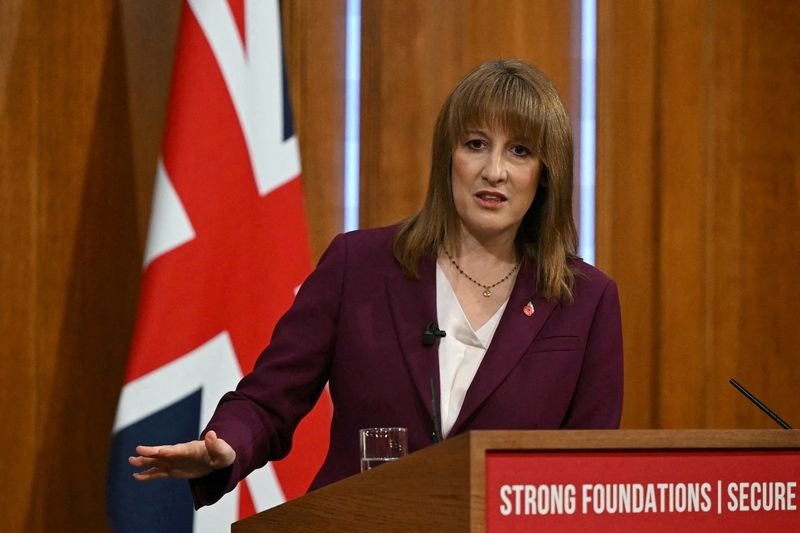
LONDON (Reuters) -Investors overseeing more than $5 trillion in assets are urging British finance minister Rachel Reeves to double the size of the country’s financial buffer against economic shocks in her November 26 budget.
Amundi, Europe’s largest asset manager, AXA Investment Managers, Allianz Global Investors and Franklin Templeton want Reeves to increase the fiscal headroom she leaves herself to meet her budget rules to around 20 billion pounds ($27 billion). Three of them said raising income tax for the first time since the 1970s was the best way to achieve this.
Reeves on Tuesday did not rule out such a tax hike, but one is not guaranteed, given the likely political damage of breaking an election pledge to keep major tax rates unchanged.
Nevertheless, investors said failing to increase the amount of spare room between the government’s spending plans and its self-imposed targets – which gives it fiscal flexibility and credibility – would risk Reeves needing to raise taxes for the third time running next year.
That would damage Britain’s standing in bond markets, which remains vulnerable even after its borrowing costs posted their biggest monthly drop in nearly two years in October, as inflation pressures ebbed.
Signs the Labour government is taking fiscal consolidation seriously have also helped, but Reeves cannot take for granted that markets will stay on her side, with the memory of the opposition Conservatives’ 2022 mini-budget crisis still fresh.
“We need to be convinced that it’s going to be translated into actual (policy),” said Amundi’s chief investment officer of global fixed income Gregoire Pesques, who has been buying British bonds as one of his most favoured trades recently.
Reeves will also need to ensure her policies do not raise inflation and ideally deliver some spending cuts to lower borrowing costs further, investors said.
RAISING INCOME TAX
Reeves’ fiscal rules include one where non-investment spending must be matched by tax revenue by 2029-30, and another where public sector net financial liabilities must fall as a share of gross domestic product.
To meet these rules, she needs to find 20 to 30 billion pounds of savings, according to various estimates from economists.
The historically slim 9.9 billion pounds of headroom she left herself in 2024 after hiking taxes by 40 billion pounds has been more than wiped out. That is due to higher borrowing costs, a U-turn on welfare cuts under pressure from Labour lawmakers and an expected downgrade of over-optimistic productivity forecasts by the government’s budget watchdog.
Doubling the headroom would help prevent this from happening again, investors said.
Reeves is expected to freeze income tax thresholds, but that would only raise 8 billion pounds, well short of what she needs to fill the fiscal hole, let alone increase headroom.
Raising income tax rates is “the easiest way of getting it done, and also the most credible way,” said AXA Investment Managers portfolio manager Nicolas Trindade, who has reduced a position favouring UK bonds recently.
David Zahn, head of European fixed income at Franklin Templeton, which manages $1.5 trillion in assets, said the government would likely need to hike the main income tax band.
A one percentage-point increase there would raise 8 billion pounds a year, versus 2 billion and 230 million from the higher and top rates, the government estimates.
While Reeves could theoretically double her headroom through an assortment of smaller tax hikes, there are not many “salami-slicing” measures available, said Oxford Economics senior adviser Michael Saunders.
Using them all would lead markets to conclude that scope for further fiscal tightening is limited, reducing the government’s ability to respond to future shocks, the former Bank of England policymaker added.
NO INFLATIONARY MEASURES THIS TIME
Investors said Reeves should also avoid measures that stoke inflation, which tops other rich economies at 3.8%.
Deutsche Bank chief UK economist Sanjay Raja said last year’s budget measures, including a higher minimum wage and increased employer social security charges, probably added 0.6 to 1.0 percentage points to inflation.
Investors hope the impact of tax hikes will prompt faster BoE rate cuts, lowering borrowing costs and offsetting some of the growth hit.
“They need to make sure that whatever policy they enact is not going to increase inflation… because if it happens, that will prevent the Bank of England from cutting rates,” said AXA’s Trindade.
A value-added tax hike is seen as unlikely given its inflationary impact. But a further rise in the minimum wage, which has increased by nearly 50% since 2019, warranted caution, investors said.
SPENDING CUTS MORE UNCERTAIN
Reeves said on Tuesday that she had “more to do” to find savings on top of 14 billion pounds of efficiency gains promised earlier this year and she had not given up on reforming welfare payments.
Investors are divided on how likely significant spending cuts are but said they should come from welfare and would help lower borrowing costs.
Spending on working-age disability benefits this year is about 40% higher than forecast four years ago, while health spending is reaching similar levels to European countries with higher tax burdens.
Amundi’s Pesques said he wanted to see over 5 billion pounds of cuts, warning: “If it’s something that’s too far ahead, it’s not going to be credible.”
Franklin Templeton’s Zahn, who is short long-dated gilts, said Reeves risked having to raise taxes again next year if she doesn’t cut spending.
“But the chances of her being able to achieve that, given the rest of the (Labour) party, seem quite low.”
($1 = 0.7451 pounds)
(Reporting by Yoruk Bahceli and David Milliken; Editing by Dhara Ranasinghe and Hugh Lawson)